

San Diego – 10x Genomics has launched Atera, a new spatial biology instrument that can analyze the entire human transcriptome in tissue samples at single-cell resolution — a combination of features that could eliminate what one researcher calls “the biggest hurdle” to large-scale spatial studies today.
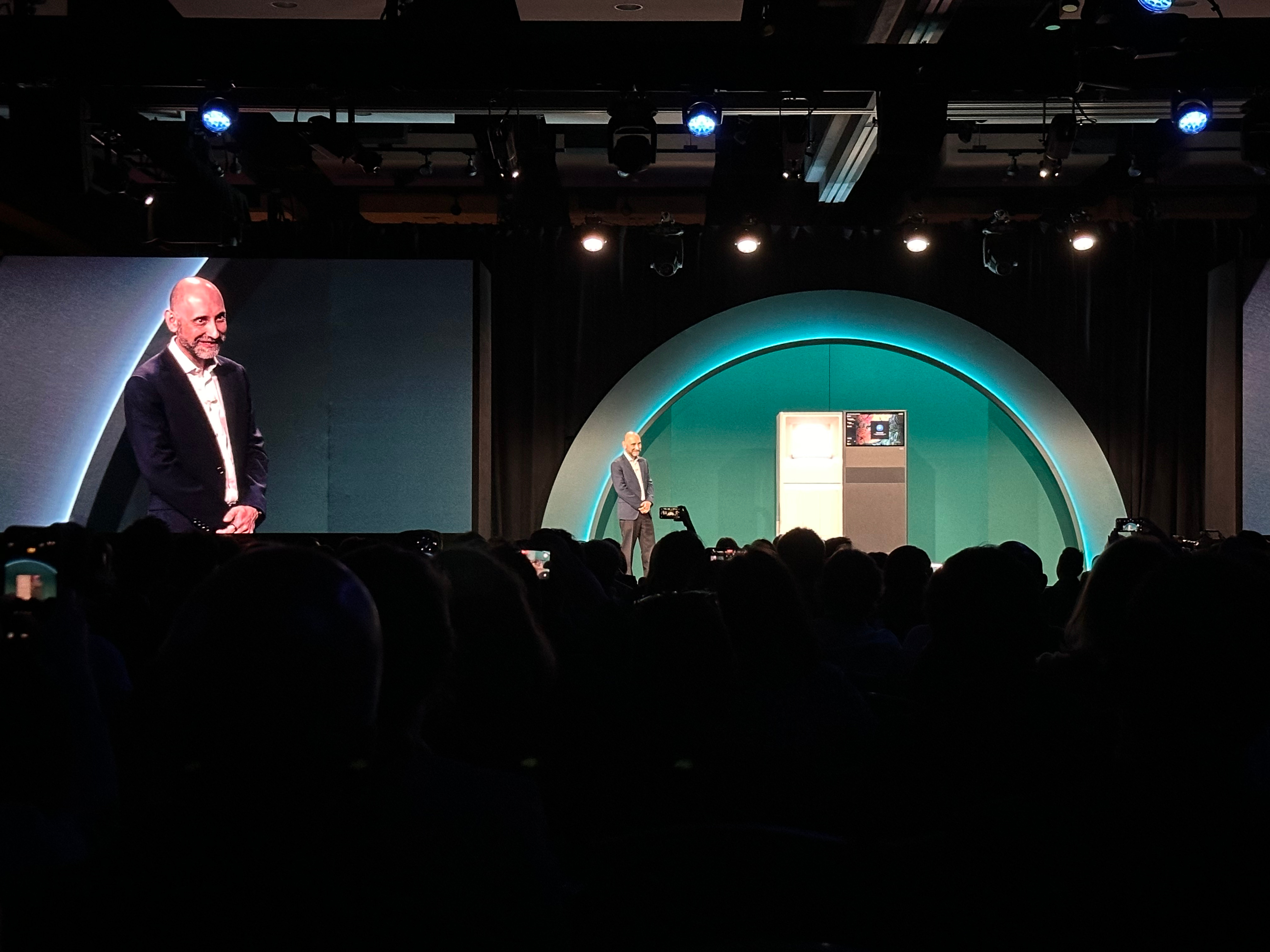
In a Saturday evening event adjacent to the American Association for Cancer Research annual meeting, company officials described it as their new “flagship” platform for spatial biology. Compared to Xenium, 10x’s spatial instrument launched in 2022, Atera offers fourfold better throughput with larger sample areas, more targets, and higher sensitivity.
Atera’s slide area is about 5 cm2 and captures the entire 18,000-gene transcriptome in about a week — the same amount of time it takes to run the largest Xenium panel of 5,000 genes (Xenium Prime 5K). Smaller Atera panels of approximately 1,000 to 3,000 genes can be run in one to three days.
“Atera has the speed and scale to support even your most ambitious projects,” 10x CEO and Cofounder Serge Saxonov told the crowd at the Hard Rock Hotel.
In addition to simply running more samples, Atera could help larger spatial studies get off the starting line by eliminating the need to design a gene panel, which is “the biggest hurdle to projects today,” according to Nick Banovich, a researcher and spatial core lab director at the Translational Genomics Research Institute (T-Gen.) “The time it takes for somebody to pick a 480-gene panel ranges between three to six months,” he said. With the whole-transcriptome [assay] available, “they don’t have to make any decisions. There’s no sort of decision fatigue. There’s no fear that they’re going to miss out on critical genes. It makes a difference.”
“I think it’s obviously a positive step for 10x to go towards transcriptomic, single-cell [spatial] analysis,” said Nigel Jamieson, a pancreatic cancer surgeon at the University of Glasgow who also runs a spatial core lab with multiple Bruker CosMx instruments, which can run whole-transcriptome assays at high resolution. At the launch event, he suggested that Atera could help 10x “catch and surpass” CosMx, though he wanted to take some time to run calculations on how much throughput he might gain by taking up Atera.
How 10x solved technical challenges inherent to imaging 18,000 molecules at a time, such as optical crowding, remains a bit of a mystery. In an interview, Saxonov declined to provide detail on Atera’s chemistry, except to note that probe-based hybridization was also an important factor in the sensitivity of its Chromium Flex single-cell assays. 10x has also made improvements to optics and data processing, according to 10x officials.
Whether Atera will replace both Xenium and Visium — 10x’s array-based, whole-transcriptome platform for fresh-frozen tissue — is unclear. So far, Visium has favored discovery applications requiring a lower resolution while Xenium has favored more targeted studies of RNA and protein.
Saxonov said Atera would not replace Xenium “at this stage.”
“We’ll see how it evolves,” he said. “As the technology scales and as the customer base scales, I would imagine we’ll see more applications move to Atera.”
Customer-submitted samples run by 10x on Atera suggest it offers real advantages compared to Visium HD and the Xenium Prime 5K panel. In a Sunday presentation at AACR, Jan-Phillip Mallm from the German Cancer Research Center (DKFZ) shared some early benchmarking data against those other 10x instruments.
Compared to Visium HD, which captures transcripts and analyzes them by sequencing, “Atera has a much broader dynamic range [with] fewer dropouts,” he said. With Visium HD, the transcript data are more binary. “It’s there, or not,” Mallm said. “Atera would be more quantitative. You can really distinguish high-, medium-, and low-expressing cells.”
Compared to the Xenium Prime 5K panel, Mallm said he saw higher transcript sensitivity for nearly all of the targets shared by both assays.
Mallm also looked at rare and other hard to detect transcripts. “We could see coexpression of markers that are rarely detected with other technologies,” including Xenium, he said. “That was striking.” These transcripts can help more precisely identify cell states.
The Atera instrument will cost $495,000, with reagents for two slides running on the order of $20,000. That works out to about $2,000 per 1 cm2 of tissue sample, Saxonov said. For comparison, the CosMx whole-transcriptome assay costs around $15,000 to $20,000 per slide (depending on order volume), with a smaller imaging area and a runtime of nearly two weeks.
Customers are already lining up, 10x said, including South Korea’s Macrogen — which aims to become a certified service provider — and France’s Bioptimus, which is building a spatial transcriptomics dataset to power its M-Optimus AI model. 10x will also launch Catalyst Research Services, which will accept samples directly from customers for whole-transcriptome spatial analysis.
Banovich said that he wasn’t bothered by the lack of information on how Atera works under the hood, for now. “That isn’t going to be a problem unless things don’t line up when you start doing head-to-head comparisons on samples,” he said, adding that his lab would likely benchmark against Xenium samples.
This story has been edited to correct runtime specs of smaller Atera panels and CosMx pricing.