

Jennifer Doudna’s lab has used AI to design genome editing proteins that outperform the CRISPR enzymes they’re modeled after, offering a new avenue for AI-powered protein design.
In a paper published July 16 in Science, Doudna’s team at the University of California, Berkeley used new AI models to design new synthetic RNA-guided nucleases that are as good or better than the CRISPR enzymes that she helped popularize.
Specifically, they used the ESM Inverse Folding (ESM-IF1) model, an AI model developed by Facebook/Meta that sort of works like Google Deepmind’s AlphaFold, but in reverse. Whereas AlphaFold takes an amino acid sequence and tries to predict the 3D structure, ESM-IF1 tackles the inverse problem: given a 3D structure, it generates amino acid sequences that would fold into that structure. They paired this model with evolution-informed constraints to generate new variants of TnpB, a CRISPR-Cas12-like nuclease.
After screening the synthetic TnpBs (synTnpBs) for activity in bacterial, plant, and human cells, they found that the variants generated outperformed the activity of the wild-type nuclease, but maintained specificity.
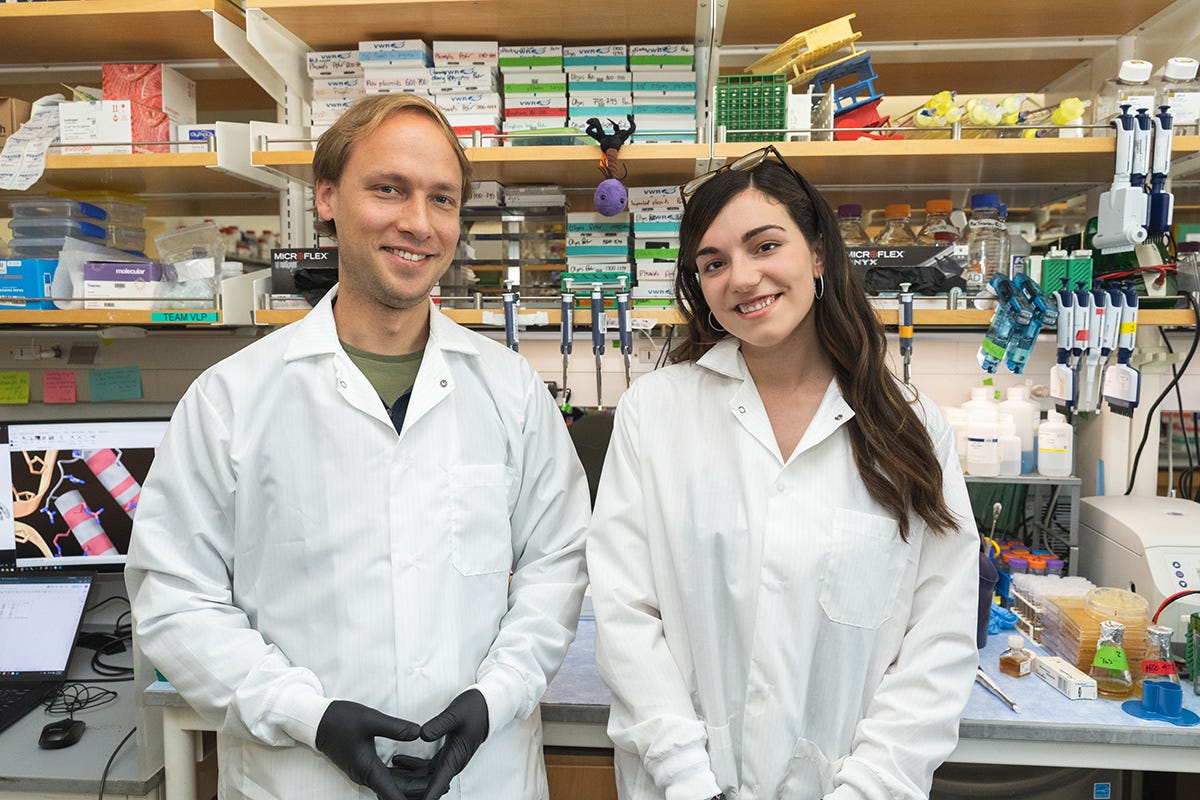
“It opens the possibility to make tailored properties on-demand for enzymes,” Isabel Esain-Garcia, a postdoc in Doudna’s lab and a co-first author of the paper, said in a statement. Nuclease activity, speed, and specificity to different nucleic acids are all potential avenues of improvement. “In the future, when we think about personalized medicine and how we have to rapidly generate new genome-editing enzymes tailored to different diseases, this type of approach where there are a lot of custom properties that can be designed quickly would be beneficial,” she said.
Researchers have already tried applying AI DNA language models to engineering CRISPR proteins, but the models usually just copy what works in nature. For some AI-designed proteins, the DNA binding domains were more than 99 percent similar to what evolution came up with, the authors wrote.
The new paper’s “structure- and evolution-guided design approach” created DNA- and RNA-interacting domains that were different by 17 percent and 28 percent, respectively. The difference in interactions between the protein and nucleic acids was confirmed through cryo-electron microscopy.
“Beyond this one protein, more importantly we established the pipeline, the set of methods to generate proteins at scale,” said Petr Skopintsev, also a postdoc and co-first author of the paper. “People can take this and apply this method for other systems.”
ESM-IF1 is based on the Evolutionary Scale Modeling family of protein language models, introduced in a 2022 preprint. ESM models are being commercialized by EvolutionaryScale, which raised $142 million in 2024.