

Grail’s Galleri multi-cancer test passed all three votes before an FDA advisory committee, but the panel was most divided on the question of effectiveness.
On Sept. 23, the Molecular and Clinical Genetics Devices Panel of the FDA’s Medical Devices Advisory Committee voted 6-4 that there is reasonable assurance that Galleri is effective for its proposed use of detecting multiple cancers “early.”
The six panelists who voted “yes” agreed the test clearly detects cancers, though several said they still wanted post-market studies and label language reinforcing that patients continue with guideline-recommended screening tests, such as colonoscopy for colorectal cancer. The four “no” votes reflected different concerns.
“The question comes down to what do you call clinical effectiveness?” said Stan Lipkowitz of the National Cancer Institute. “As an oncologist, I generally look at that as outcomes, and we don’t have that data.”
Another “no” vote, Daniel Swerdlow, a radiologist at Georgetown University, also questioned whether there was any demonstration of effectiveness and also raised concerns about the impact Galleri would have on demand for follow-up testing.
“There simply aren’t enough physicians to do this,” he said. “We already don’t have enough trained endoscopists in this country to do the routine screening colonoscopy that needs to be done in this country” and there is a “massive shortage of radiologists,” as well.
“It’s one thing for one company to start this, but when they all start coming online, they’re not going to get read in any timely fashion because there just simply aren’t enough bodies to go around further,” he said.
Charity Morgan, a biostatistics expert at the University of Alabama at Birmingham, voted “no” specifically because Grail’s proposed label still used the word “early,” and suggested she would change her vote to yes if the label were changed.
Another, Lordi Dodd of National Institute for Allergy and Infectious Disease, said she voted “yes” on effectiveness “assuming the label is changed to remove the ‘early’ part... that’s why I voted yes, but I have a lot of concerns about its broader clinical impact long term.”
The same panel was unanimous, 10-0, on the test’s safety, and voted 7-2, with one abstention, that Galleri’s benefits outweigh its risks.
The labeling question ran through much of the meeting. The panelists ultimately coalesced around dropping “early” in favor of simply “detection,” and agreed the test should be described as detecting a “cancer signal” shared across tumor types, verbiage taken from Grail’s own proposal for its test label.
“The panel agreed on calling this a test for a ‘cancer signal’ but also want to be clear that it does not detect ‘all cancer’ in order to mitigate risks that patients forgo other screenings,” Guggenheim Securities Analyst Subbu Nambi wrote in a Sept. 23 note to investors. “While the label may remove the “early detection” language in favor of simply “detection”, we don’t think this will matter in clinical practice,” she added.
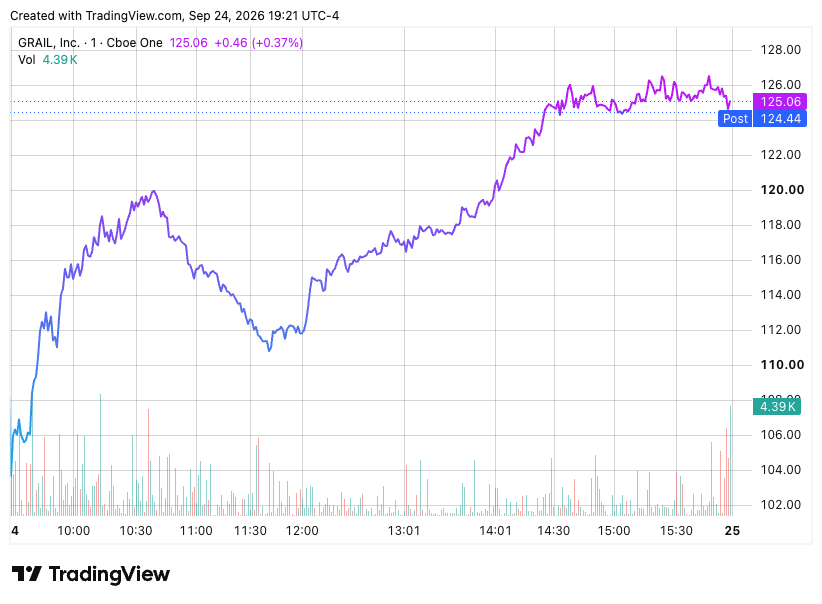
Grail stock again jumped on news of the vote, up 15 percent in Sept. 24 trading on the Nasdaq at $125.21.
“Today’s vote reinforces the strength of Galleri’s clinical evidence,” Grail CEO Josh Ofman said in a statement.
Galleri, which the FDA designated a Breakthrough Device in 2018, is supported by data from the PATHFINDER 2 and NHS-Galleri studies. Grail submitted its premarket approval application on Jan. 29, 2026, and the FDA is expected to issue a final decision in the coming months. The FDA is not bound by the committee’s recommendation.