

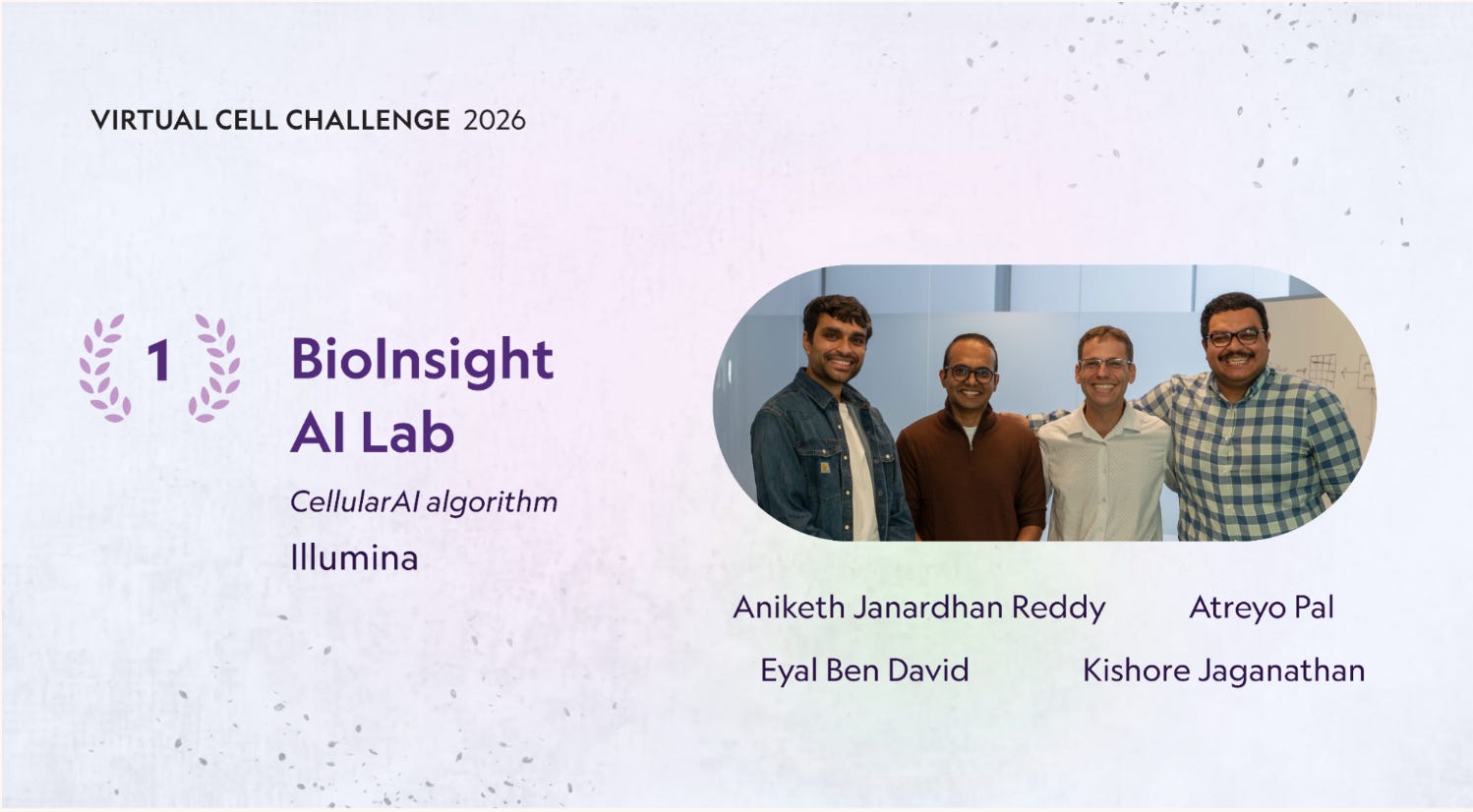
A team of bioinformaticians from Illumina has won the 2026 Virtual Cell Challenge, a competition that tests the ability of AI models to predict the results of genetic perturbation experiments.
“The real story behind this result isn’t just the algorithm,” Eyal Ben David, an Illumina bioinformatician and VCC team leader said in a LinkedIn post. “Our CellularAI framework is only as good as the biological foundation underneath it. Our model worked because of the depth, diversity, and quality of Illumina’s Billion Cell Atlas,” a proprietary CRISPR perturbation screening dataset used to train their model.
Along with Aniketh Reddy, Atreyo Pal, and Kishore Jaganathan, the Illumina team used over 200 million perturbed cells from 57 cell lines as well as an agentic AI-based development process to build their Cellular AI model, which the company is releasing as open-source software.
Second place went to the independent team of Sina Kodaveisi and Navid Bagheri while the final spot on the podium went to a team from AI-first drug discovery company Xaira Therapeutics, comprising Jineyop Song, Tanush Kumar, and Julie Chow.
While academic teams from Columbia University, the University of Texas at Austin, and the University of Chicago placed in the top 10, corporate-backed squads topped the leaderboard, with a team from the Novo Nordisk Foundation placing fifth and South Korea’s AgingLab placing sixth.
“Today’s models add little beyond what a measurement in another cell line already tells you.”
“This year’s competition was actually a lot more challenging than last year,” David Burke, an AI advisory board member at the Arc Institute, which organizes the challenge, said during the awards ceremony held Nov. 19. “Competitors were asked to predict the transcriptional response to 300 CRISPRi perturbations in three cell lines for which no perturbation data is publicly available, so it’s a zero-shot challenge.” The organizers did not provide any perturbation data from the six cell lines used, putting an emphasis on data use to train models.
“Notably, all three winning entries were modular pipelines rather than single end-to-end models that map a control state and a perturbation to a population of cells,” the Arc Institute wrote in a blog post covering the results.
Only one team on the podium, from Xaira, used a foundation model at all, and only used it to select which measured effects should be carried over to predictions, and to generate cell results directly.
While both the Illumina and Xaira team had access to private data, the second-place team got there using only publicly-available data, including 222 perturbation data sets in 86 cellular contexts.
Overall, models “significantly improved” compared to the inaugural competition held last year, the Arc Institute said, but still have “a long way to go.”