
Illumina launches StrataMap Spatial Solution
Yesterday, Illumina officially introduced StrataMap, its new spatial transcriptomics product. The sequencing-based technology offers a large capture area, single-cell resolution, and profiling across the transcriptome.
Simply put:
“It’s fire,” Anoja Perera, director of sequencing and discovery genomics at the Stowers Institute told me earlier this year. “It looks incredible, it’s like nothing else on the market.”
Illumina highlighted how StrataMap can scale up to process more samples. The capture area is 7.5 cm2, enabling several sections to be placed on the same slide and sequencing time of as little as 22 hours, with a total turnaround time of about 5 days. It runs on both the high-throughput NovaSeq and mid-throughput NextSeq instruments.
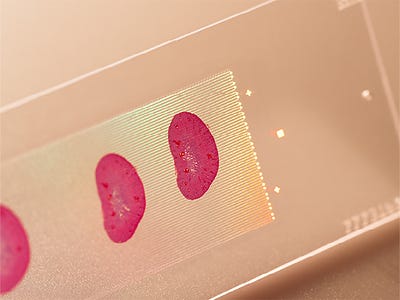
Unlike some competitors, StrataMap currently works only with fresh-frozen tissue. Illumina said it is developing an FFPE-compatible version, though no firm launch date has been announced. This limits immediate adoption for studies using banked samples.
Other customers who have already run samples on StrataMap include Ioannis Vlachos, director of the spatial technologies unit at Beth Israel Deaconess Medical Center, who studied 3D tissue organization from serial sections.
“StrataMap Spatial exhibited high sensitivity, which enabled us to shed light on these exceptionally challenging samples,” Vlachos said in a statement. “StrataMap’s large capture area permitted us to place multiple serial sections to establish whole transcriptome, single-cell resolution, 3D maps of these exceptionally precious tissues and unlock novel biology.”
A UK-based team evaluated glioma and glioblastoma tissues to characterize their complex tumor microenvironment, with the ultimate goal of guiding more precise surgical interventions and personalized treatment choices.
“Until now, we were unable to study large tissue sections in CNS and other cancer types at a whole-transcriptome, single-cell level,” Ania Piskorz, head of genomics at the Cancer Research UK Cambridge Institute and University of Cambridge, said in a statement. “Unlocking the ability to profile these large tissue sections will provide deeper insights into the tumour microenvironment. It will help us build more informative tumour maps, identify mechanisms of treatment resistance, and improve our ability to predict patient therapeutic responses.”
AI, Synthetic DNA, National Security Leaders Ask Congress to Mandate Screening for DNA Orders
Dozens of people involved in the fields of nucleic acid synthesis, artificial intelligence, academic research, and national security have penned an open letter asking for the US Congress to write laws mandating screening of synthetic DNA orders.
AI systems now outperform PhD-level virologists on questions about highly technical laboratory procedures in their own domains of expertise. The evidence about what this means for present-day biosecurity threats is genuinely mixed, but the trend is hard to dispute. AI systems are improving rapidly, and alongside incredible benefits to science and medicine, there is a real possibility that the knowledge barriers which have historically prevented bad actors from obtaining biological weapons will meaningfully erode [...]
Congress should act this session, and we applaud the legislative efforts currently underway. To ensure a consistent national standard rather than a patchwork of conflicting laws, states should also consider implementing requirements based on existing federal and industry guidelines.
Key signatories include Demis Hassabis, Nobel laureat and CEO of Google DeepMind; Twist Bioscience CEO and cofounder Emily Leproust; OpenAI CEO Sam Altman; Anthropic CEO Dario Amodei; Ansa Biotechnologies CEO Jason Gammack; University of Washington researcher and Nobel laureate David Baker; and Stanford University’s Drew Endy.
10x Genomics acquires Proteintech Genomics
10x will obtain barcoded antibody cocktails that provide information about many types of proteins in a cell, not just those on the cell surface. The assays, which were designed to work with 10x’s Flex single-cell transcriptomics technology, include protein detection panels and cell hashing antibodies for sample multiplexing.
10x did not disclose deal terms; however, according to Guggenheim Securities Analyst Subbu Nambi, 10x officials indicated that the deal was “smaller” than the company’s $30 million acquisition of Scale Biosciences.
With the purchase, 10x expands its multiomic capabilities at a time when single-cell data is shaping attempts at artificial intelligence-based virtual cell modeling.
“Bringing scalable protein measurements into single-cell and spatial biology is an important step toward richer, more predictive views of cellular state — and ultimately, virtual cell models that better reflect the complexity of living systems,” Ci Chu, senior VP of AI-Enabled Discovery at AI-based pharmaceutical company Xaira Therapeutics — a customer of both 10x and Proteintech Genomics — said in a statement.

Google DeepMind, Wellcome Sanger Launch AI-Focused Genomic Data Consortium
The Wellcome Sanger Institute and Google DeepMind announced a new consortium for the use of artificial intelligence in genomics. The consortium aims to generate high-quality, AI-ready genomic datasets designed to train advanced machine learning models. The datasets will provide a foundation for training and evaluating AI models capable of making more accurate predictions about biological processes, the partners said.
Google DeepMind and Google.org, Google’s philanthropic arm, have committed $5 million per year over five years.
Natera teams up with CytoDyn on metastatic colorectal cancer study, adds board members
Natera will apply its Signatera assay — a tumor-informed, sequencing-based test for minimal residual disease (MRD) — to patient samples from CytoDyn’s Phase 2 study of leronlimab, an antibody therapy, in metastatic colorectal cancer (mCRC).
Natera also increased the size of its board from 11 to 12 members with the addition of Thomas Lynch, effective June 2. The company also added Eric Rubin to its board.
The appointments could help support Natera’s efforts in clinical integration and pharmaceutical partnerships. Both Lynch and Rubin bring relationships in oncology and immunotherapy development, areas where Natera’s MRD testing is proving critical to clinical decision-making.
Lynch is president and director of Fred Hutch Cancer Center. Prior to joining Fred Hutch, he was CSO at Bristol Myers Squibb, CEO of Massachusetts General Physicians Organization, and director of Yale Cancer Center, among other leadership roles. Rubin was most recently senior VP of global clinical oncology at Merck, where he led initial development of Keytruda (pembrolizumab), the first anti-PD-1 therapy in the US.
Sophia Genetics, Memorial Sloan Kettering to form joint venture
Sophia Genetics and Memorial Sloan Kettering Cancer Center have signed a memorandum of understanding to form a joint venture focused on developing and deploying precision oncology tools to patients worldwide.
The proposed hub, announced June 4, would combine MSKCC’s clinical data and scientific expertise with Sophia’s SOPHiA DDM platform, which provides analytics tools for precision medicine. Under the envisioned structure, SOPHiA DDM would serve as the hub’s AI, data, and bioinformatics backbone, while MSKCC would contribute its oncology faculty, clinical leadership, and capacity to generate high-quality patient data.
Sweden, The Netherlands Team Up on WGS in Cancer
Genomic Medicine Sweden (GMS) and the Netherlands’ Hartwig Medical Foundation signed a memorandum of understanding to formalize a strategic partnership centered around whole genome sequencing (WGS) and precision oncology in routine cancer care across the two European countries.
Haga Bioscience Raises $2.2 million Seed Round
Swedish startup Haga BioScience said it will use the funding to begin commercializing its spatial biology technologies, which are designed for clinical validation and translational workflows. The company’s platform enables sensitive and specific detection of single nucleotide variants (SNVs) in RNA in situ, via methods developed by cofounders Hower Lee, Marco Grillo, and Mats Nilsson.
Haga’s cofounders include Malte Kuhnemund and Xiaoyan Qian, who along with Nilsson cofounded Cartana, a SciLifeLab spinout acquired by 10x Genomics. 10x then integrated Cartana’s in situ RNA sequencing technology into the Xenium spatial instrument.
Sniffles 2 for Structural Variant Calling
“This is basically the paper for everyone who has ever asked:
‘Okay, I have long-read data… now how do I actually call SVs properly?’” senior author Fritz Sedlazeck of Baylor College of Medicine said in a LinkedIn post. His team published their paper June 8 in Nature Protocols.
“We walk through practical workflows for: germline SV calling joint calling across trios, tumor/normal pairs and populations mosaic SV calling at low allele fractions VCF/SNF outputs, plotting, runtime and troubleshooting,” he said.
Mission Bio to offer discounts to Human Cell Atlas Researchers
Under a new collaboration, Human Cell Atlas members will gain discounted access to Mission Bio’s Tapestri single-cell multiomics platform as well as access to Mission Bio’s validated assay portfolio, bioinformatics support, and custom assay development capabilities.
What I’m Reading
In an attempt to minimize screen time at night I’ve endeavored to read more in bed. This weekend I started Jane Eyre by Charlotte Brontë and so far, it’s working: I only made it six pages the first night before falling asleep.
Elsewhere on the Internet
I’m not a New York Knicks fan, however, I’m always a fan of New Yorkers expressing love for the city.
One man’s reaction to Game 1 of the NBA finals, captured in a social media video, has become a movement: