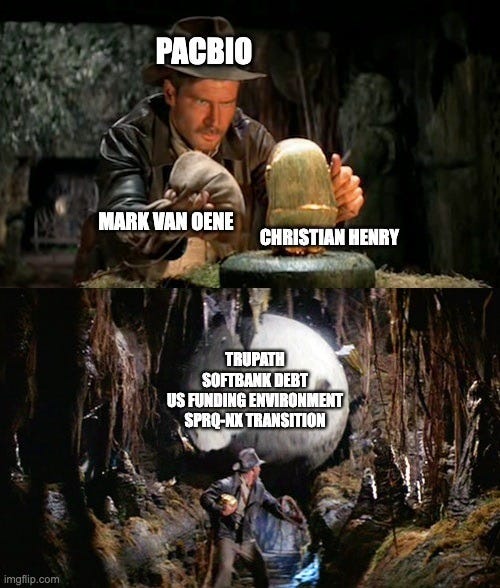
The genomics world is still reacting to the change of CEO at Pacific Biosciences, announced last week ahead of second-quarter earnings.
Former Oxford Nanopore Technologies CTO Clive Brown wasted no time serving up food for thought:


The full post continues:
… (in the west). The combined IP portfolio would be formidable and the combined entity - a juicier acquisition target. ONT gets on NASDAQ and likely a valuation uplift with $450M+ revenues. ONT shareholders would need to be in the driving seat. New board for ONT.
Over on LinkedIn, genomics commentator Alex Dickinson picked up the idea and ran with it, adding the following points, among others:
PacBio and ONT have been duking it out over a small part of the total sequencing market for years.
The costs of operating as a single publicly-traded company would help the long-term economics.
A deal could give ONT shareholders a large stake in a company based and traded in the US, where there’s a lot more money sloshing around and more likely to invest in genomics.
Such a deal could circumvent PacBio’s debt issues (which are above my paygrade.)
I don’t know if this helps the case to make this happen or hurts it, but my own thoughts are that PacBio and ONT have developed subniches within the long-read market resulting in mostly non-overlapping customer bases (excluding core labs.) Oxford Nanopore has done well with researchers who need speed and flexibility, including in metagenomic sequencing, especially in the field. PacBio had leveraged its accuracy to get into more clinical and human health-related applications.
Nanopore sequencing is finding a place in the clinic, again using speed as its differentiator, for rapid newborn whole-genome sequencing and intra-operative classification of brain tumors. Both are useful in telomere-to-telomere genome assemblies.
I recently spoke to new PacBio CEO Mark Van Oene for feature on the leadership transition (more on that next), we discussed whether it was important for PacBio to operate as a standalone company. He thought that it should at least stand alone. But could it and ONT benefit from standing together?
I published that feature story earlier today. According to both Van Oene and the man he replaced, Christian Henry, the succession was “always part of the plan” from the moment Henry brought Van Oene on board as chief operating officer.
New PacBio CEO Has Been Preparing for His Moment

Like a Hemingway bankruptcy, Mark Van Oene rose to the top job at Pacific Biosciences gradually, and then suddenly.
I also delved into the challenge facing Van Oene:
Regardless of how he got here, [he] is now strapped into a two-stage rocket of Henry’s making. Over the next year or two, Van Oene will need to pull off a transition to new reusable consumables that allow PacBio a price per genome that is at least competitive with short-read sequencing. Following that, he’ll need to correctly time and execute the launch of PacBio’s next instrument, a production-scale long-read sequencer that can make use of the lower sequencing costs while meeting the demands of larger human sequencing endeavors, such as clinical and population sequencing.
Ion Genomics News
Check out this Raw Reads entry, a collection of everything 10x Genomics CEO and Cofounder Serge Saxonov said about AI on his Q2 call with Wall Street analysts:
Other genomics news
Illumina Settles Icahn-Led Shareholder Suit Over Grail Saga
Illumina has reached a settlement with billionaire investor Carl Icahn and other shareholders in a lawsuit over the company’s disputed reacquisition of Grail, according to an Aug. 7 filing with the US Securities and Exchange Commission.
Natera Q2 Revenue Jumps 38 Percent, Company Raises Full-Year Outlook by $100 Million

Natera said on Aug. 6 that its second quarter revenue rose 38 percent year over year, driven by strength in its Signatera test.
10x Genomics Q2 Revenue Falls 13 Percent on Decline in Patent Suit Windfalls
This story has been updated to correctly identify 10x’s CFO as Adam Taich, not Adam Laponis, who is CFO at Twist Bioscience.
Speaking of 10x: Spatial Genomics, a company commercializing sequential fluorescence in situ hybridization (seqFISH) technology, and CalTech, where researcher Long Cai developed the tech, have sued 10x Genomics in US Federal court, alleging patent infringement.
Specifically, the plaintiffs allege that 10x’s Xenium spatial analysis instrument infringes several patents, including US Patent No. 10,457,980 titled “Multiplex Labeling of Molecules by Sequential Hybridization Barcoding.”
The plaintiffs have asked the court to file their complaint under seal. A redacted version of the complaint says Spatial Genomics sells an instrument called GenePS, based on seqFISH technology; however, it’s unclear how many boxes the company has placed.
According to a paper published earlier this year in Chemical & Biomedical Imaging, seqFISH offers the ability to:
connect dynamic phenotypes exhibited by individual cells with their corresponding genotypes. However, widespread adoption of this strategy has been constrained by two technical challenges: (1) compromised in situ genotyping efficiency due to nonspecific fluorescent probe aggregation in confined microfluidic growth chambers, and (2) the reliance on high-copy-number plasmids to ensure genotyping sensitivity, which often distorts dynamic phenotypes and perturbs normal physiology during live-cell imaging.
Broken String Biosciences has launched an extension of its INDUCE-seq technology to support adenine base editing workflows. The company has also launched an early access program where it plans to work with researchers developing genome-editing therapies.
Elsewhere on SubStack
Nava Whiteford brings us a view of the electronic guts of a MinIon flow cell, based on a tear-down video from YouTube.

“As previously estimated this is likely a [bill of materials] cost in the $200 range,” he wrote. That’s compared to the list price of $840 for a MinIon Flow Cell.
Over at BridgeCross Bio, Matt Marlowe reports that WuXi AppTec has scored an early win in its fight its inclusion on the so-called 1260H list recently issued by the US Department of Defense.
On 7 August, US District Judge James Boasberg granted a preliminary injunction preventing the Department from enforcing WuXi’s designation as a “Chinese military company” while litigation continues. The court also rejected the Department’s request to pause the injunction pending an appeal…
According to the opinion, the case has revealed that a DoD report mistakenly said that a Chinese government-linked investment fund owned 5.2 percent of WuXi AppTec, when in reality that figure was percentage of the total fund allocated to shares in the company.
The fund appears to only own approximately $200,000 worth of shares, not 5 percent of the company, which would have been worth hundreds of millions of dollars.
Also, another piece of evidence used by the DoD turned out to be documents listing WuXi AppTec as a “third-party laboratory” by pharma giant Novo Nordisk as it sought to do business with China’s Ministry of Science and Technology.

However, damage has already been done. “In the weeks since publication, WuXi’s customers and suppliers have canceled contracts, terminated longstanding relationships, and moved their business to competitors,” the judge noted.
The incompetence on display certainly raises questions about other additions to the list.
My Omics Reading List
Eapen, et al. “An Integrated Spatial Multi-Omics Workflow for Sequential RNA and Protein Profiling in FFPE Tumor Tissue.” Cancer Research Communications. Aug. 7, 2026.
Here, we present an integrated spatial multi-omics workflow that enables sequential mapping of hundreds of genes via the [10x Genomics] Xenium In Situ platform and over 40 protein markers via [Standard BioTools] Imaging Mass Cytometry technology on a single formalin-fixed, paraffin-embedded (FFPE) tissue section.
King, et al. “Generative design of bacteriophages with genome language models.” Science. Aug. 6, 2026.
Researchers at Stanford University and the Arc Institute used the Evo genomic language model to computationally design complete bacteriophage genomes from scratch, then tested them against Escherichia coli that had evolved resistance to a natural phage.
Experimental tests yielded 16 functional genomes with diverse sequences, structures, and fitness profiles. A cocktail of the generated bacteriophages rapidly overcame bacteria that had evolved resistance to a natural bacteriophage. This work lays a foundation for AI-guided design of biological function at the whole-genome scale.
Elsewhere on the internet