

A UK-based researcher has uncovered what appears to be systematic image manipulation in antibody validation data on Thermo Fisher Scientific’s website, prompting other scientists to comb through the company’s product listings for additional cases of doctored results.
On May 17, Sholto David, a UK-based researcher and scientific misconduct sleuth, posted on social media that Thermo Fisher’s website “appears to show a fake Western blot for the validation of one of their p53 antibodies [...] This does not appear to be one of the ‘published figures,’ but their own internal data.”
“The images are 100 percent improperly edited,” David, who previously uncovered image manipulation that led to a $15 million settlement by Dana-Farber Cancer Institute, said in an email. “Some of the most obvious I’ve seen.”
His post included an image suggesting that one of the bands in the Western blot had been flipped or rotated around various axes and pasted into multiple other lanes.
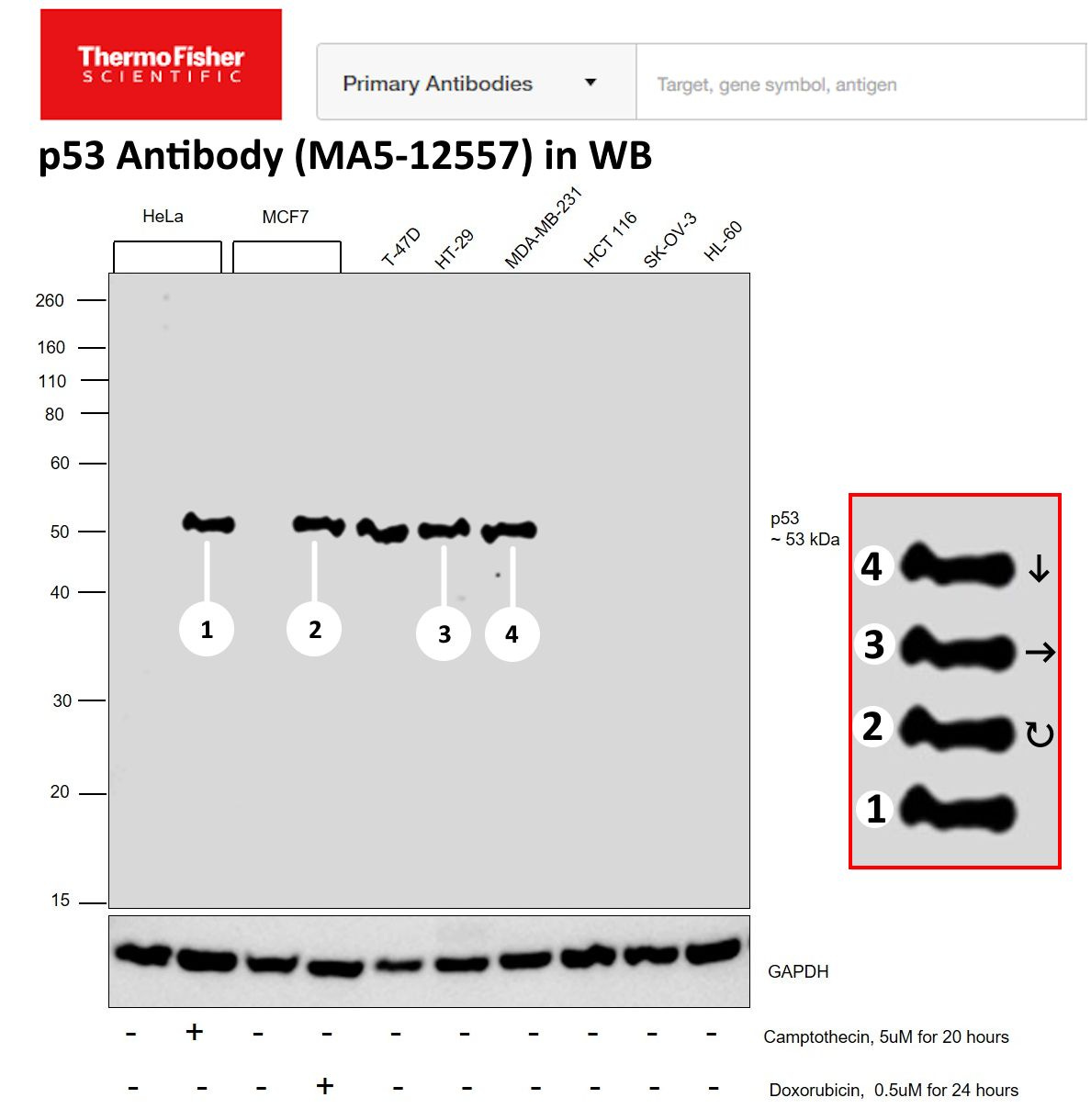
As of May 27, many of the allegedly manipulated images remained on the Thermo Fisher website. The company did not respond to multiple requests for comment.
David’s post sparked others to search Thermo Fisher’s website, and they found similar patterns across multiple product lines. In total, multiple antibodies — including four p53 variants as well as Tau, Retinoblastoma protein, NLGN1, and Caspase 7 antibodies — showed evidence of image manipulation.
What implications the allegedly faked validation data could have isn’t clear. “The images are supposed to show that the antibodies bind specifically to their targets,” David said, noting that it’s possible the reagents do actually work.
“If people manipulate images they usually do that to make the data show something it doesn’t. In this case, I suppose the blots do not come out so clean? Perhaps there are some minor bands or unexpected binding in negative controls? From commentary online it seems like people have good experiences with the antibody clone that I first mentioned, I doubt it’s just totally false,” he said.
Thermo Fisher may not be alone in providing questionable data for its antibodies. “I’m working on something else [...] that absolutely will show widespread confusion/fraud related to antibodies sold by Abcam, stay tuned,” David wrote in response to a comment on LinkedIn.
Image manipulation of Western blots and other scientific data have plagued the peer-reviewed literature and federal grant applications for years. The consequences can be tangible: last year, Dana-Farber Cancer Institute settled a False Claims Act lawsuit for $15 million after David discovered image manipulation in papers and grant proposals submitted to the National Institutes of Health by researchers at the institute. As a whistleblower, David secured a $2.6 million payout.
Whether Thermo Fisher could be subject to a similar suit — say, if federal grant funding had been used to purchase these antibodies — is also unclear. For now, David said he hasn’t considered filing such a suit.
What’s certain is that his most recent sleuthing has struck a nerve, with dozens of comments and over a thousand reactions on LinkedIn alone.
“This explains the need to try 3+ antibodies and do validation by KO to get reliable data,” Kirill Bersuker, a scientist at the Google-associated company Calico Life Sciences, wrote in reply to one of David’s LinkedIn posts. “That’s thousands of dollars and days of research time.”
David speculated that without other quality indicators available “you might just choose the one with the prettiest blot on the supplier’s website. For that reason I can see why people feel pissed.”