

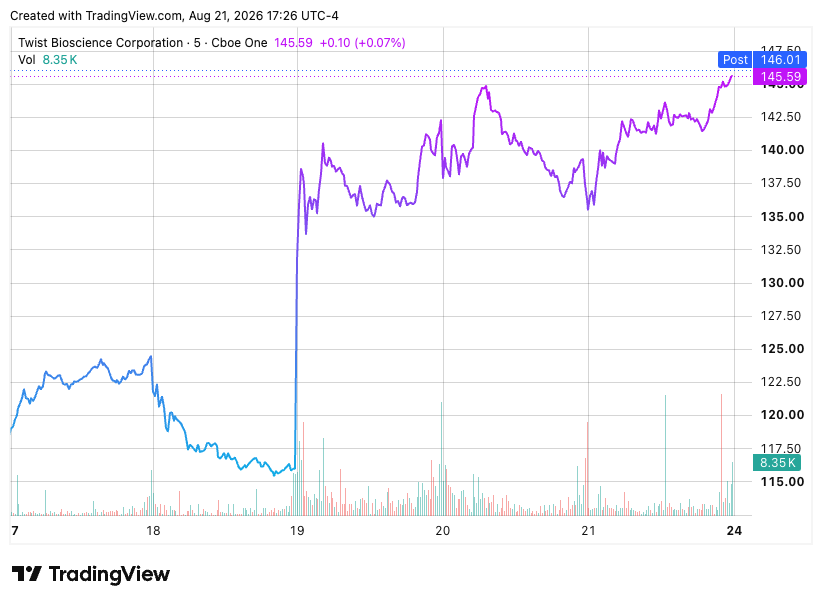
Twist Bioscience saw its share price jump nearly 25 percent from where it began the week, with the biggest rise following an Aug. 19 announcement from artificial intelligence company Anthropic that it has used Twist to verify its investigational work into AI-designed proteins.
In a blog post, Anthropic said it had used its recently-launched Claude Science to design so-called minibinders, or small proteins designed to bind a larger target. Wet lab work from Twist and Adaptyv Bio, a Swiss lab that touts itself as being “built for AI-first protein engineering,” showed that Claude went 14 for 15 on designing binders for targets including PD-L1, VEGF-A, IL-7R⍺, EGFR, and SpCas9.
Overall, 354 out of 1,320 designed proteins bound their target, an overall hit rate of 27 percent, though per-target hit rates varied widely.
“This case study shows that Claude is at least expert-level at orchestrating protein design tools,” Adaptyv wrote in a separate blog post. “That’s great news, since protein design tools are hard to use. Before AI, even setting up a protein structure prediction tool could take hours of debugging.”
The collaboration with Anthropic seemed to ease some investor doubts that Twist stood to benefit materially from AI-driven drug discovery. The company has been touting its growth there for nearly a year and on Twist’s most recent earnings call, CEO and Cofounder Emily Leproust said she expects AI-enabled drug discovery orders to double by the end of its fiscal year 2027 to approximately $100 million.
“After important partnerships (e.g., Amazon Bio Discovery) and publicly proven results (e.g., Anthropic’s Claude Science) we are increasingly confident that Twist is poised to play an important role in AI model building through the critical validation of key AI outputs,” Canaccord Genuity Analyst Kyle Mikson wrote in an Aug. 19 note to investors.
The protein binding experiment was accompanied by an experiment into whether Claude models could accelerate chemical analysis. Anthropic’s conclusion was that it could: using only raw files from a contract lab and a two-sentence prompt, Claude returned finished nuclear magnetic resonance spectroscopy and mass spectrometry results in under 25 minutes, matching the lab’s own purity analysis.
Anthropic noted that both the protein design and data analysis tasks are “representative of the work that makes up some parts of the early stages of the drug development process. Accelerating these phases is one component of our much larger effort to speed up drug development end-to-end, many aspects of which have more to do with policy and operational bottlenecks than with improvements in core scientific capabilities.”
The protein design work was “carried out with minimal human involvement beyond the information we provided Claude in our initial prompt,” Anthropic wrote, suggesting that guidance from experts in the field could yield even stronger results.
The experiments underscore how Anthropic is courting the scientific community, especially in life sciences, a strategy that sets it apart from many of its competitors. Last month, Anthropic announced that it was launching Claude Science, which can do various tasks besides protein design, including assisting in literature reviews as well as analyses of data such as germline variants in disease and single-cell gene expression data.

Anthropic has garnered headlines for how its newest models, including Mythos and Fable, have vastly improved their core capabilities, including writing code. The company noted that “life science research tasks are currently blocked in our most capable model,” (likely Fable) but said “one of our highest priorities” is to launch an access program for scientists, with more details to come “soon.”