


“What if every biomedical scientist had a tireless expert collaborator? One that could actually go read literature, one that could actually go run the analysis, understand the data, design the experiments across any area of biology?”
That’s what Stanford computer scientist and computational biologist Jure Leskovec said he wanted when he started work on Biomni, a “general-purpose biomedical AI agent” formally introduced yesterday in Science.
“Most AI models in biology today are very specialized: for one specific task, for one specific data type, for one specific prediction,” he said in a press conference associated with the paper’s publication. “They are very powerful, but they are kind of locked into a single problem, and Biomni is not. [It] sits on top of these specialized tools and can execute long-range multi-step tasks across the whole landscape of biomedicine, from genetics to genomics, immunology, pharmacology, microbiology, and so on.”
Started in 2024 and put up as an open-source project in 2025, Biomni appears to be the first such agentic AI research tool. It’s already being commercialized by a startup, Phylo, and heralds a new wave of technologies standing on the shoulders of the large language models behind products like Google Gemini and Anthropic’s Claude.
Just last week, Anthropic launched Claude Science, another wide-ranging research aide that is also based on AI agents. And a major leap in Claude’s ability to write code means even more are likely on the way.
Researchers are already lining up to try them out. According to Leskovec and his Phylo cofounders Kexin Huang and Jerry Qu, more than 10,000 people have already started using Biomni. Whether they’ll choose to use it to augment the work of lower-level researchers or use it to replace them remains to be seen.
Leskovec is hopeful it will let trainees move off tedious work and “[let] the junior scientist get to the interesting, judgment-heavy part of the work faster,” he said. “Because Biomni is general, it means that any junior scientist now has access to this seasoned collaborator who is also an expert in, and knows how to use, tools from other disciplines or sub-disciplines.”
My guest this week, Johnny Yu, has seen firsthand how the new code-writing capabilities of LLMs has opened new horizons for the use of AI in biology. Tahoe Bio, a company he cofounded, has built its own AI agents, which are helping it rethink how to use AI in drug discovery and development.
Join us to learn more about what AI agents are, how they’re made, how they’re changing discussions about the impact AI can make in biology, and the limitations they’ll still face.
You can also listen to the interview on Apple Podcasts and Spotify:
Show notes
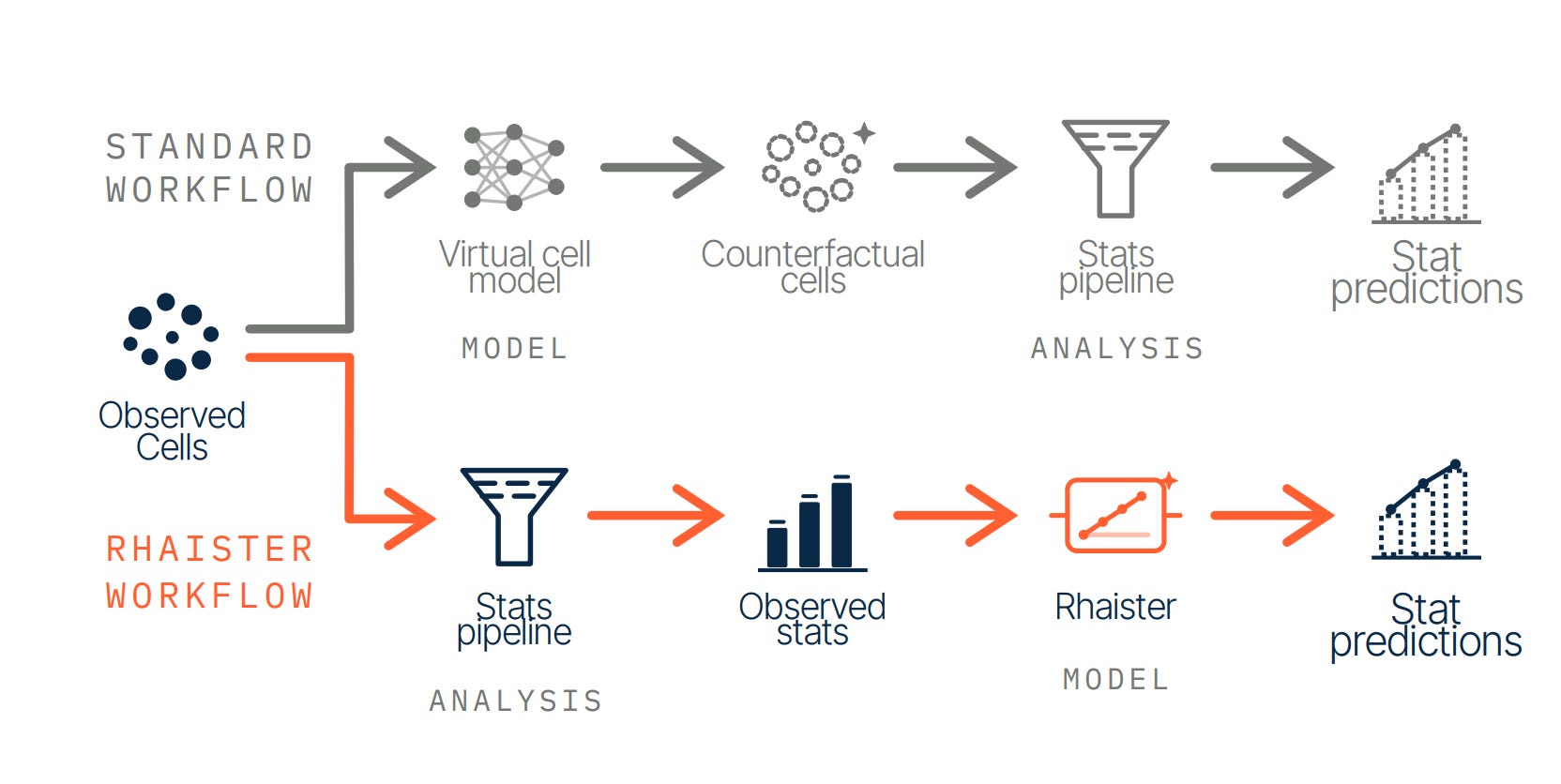
Tahoe Bio graphic on the difference between biology models and reasoning models
Claude science blog post https://www.anthropic.com/news/claude-science-ai-workbench
Phylo: https://phylo.bio/about
LinkedIn post from Johnny on Rhaister and Tara:
The question we keep coming back to at Tahoe: if reasoning models can now generate a thousand hypotheses in seconds, what's actually the bottleneck?
It's verification — and verification is data. Every hypothesis eventually comes down to: does this hold up against real biological measurements? Not data scraped from papers that don't reproduce, but data you generated yourself, at a scale and diversity that lets you actually trust the answer.
That's what we've been building. An ocean of perturbative single-cell measurements — primary cells, organoids, immune contexts — that serves as ground truth for biological reasoning. Rhaister, our ML model, learns from the structure of that data to predict how cells respond to perturbations they've never seen. It trains in seconds. Runs in milliseconds. And generalizes zero-shot to new biology.
Then Tara, our autonomous research agent, closes the loop — generating hypotheses, validating them against the data, and surfacing real discoveries in hours instead of years.
Blog post from Tahoe Bio CEO and Cofounder Nima Alidoust:
Building a generalizable model of the cell is a worthy ambition. It will be a bigger moment than AlphaFold. But with reasoning models in hand, I think we can do some of what we imagined that model would do, before we ever finish building it.
One way to get there is to couple reasoning models tightly with the data we once used only to train biological models.


