


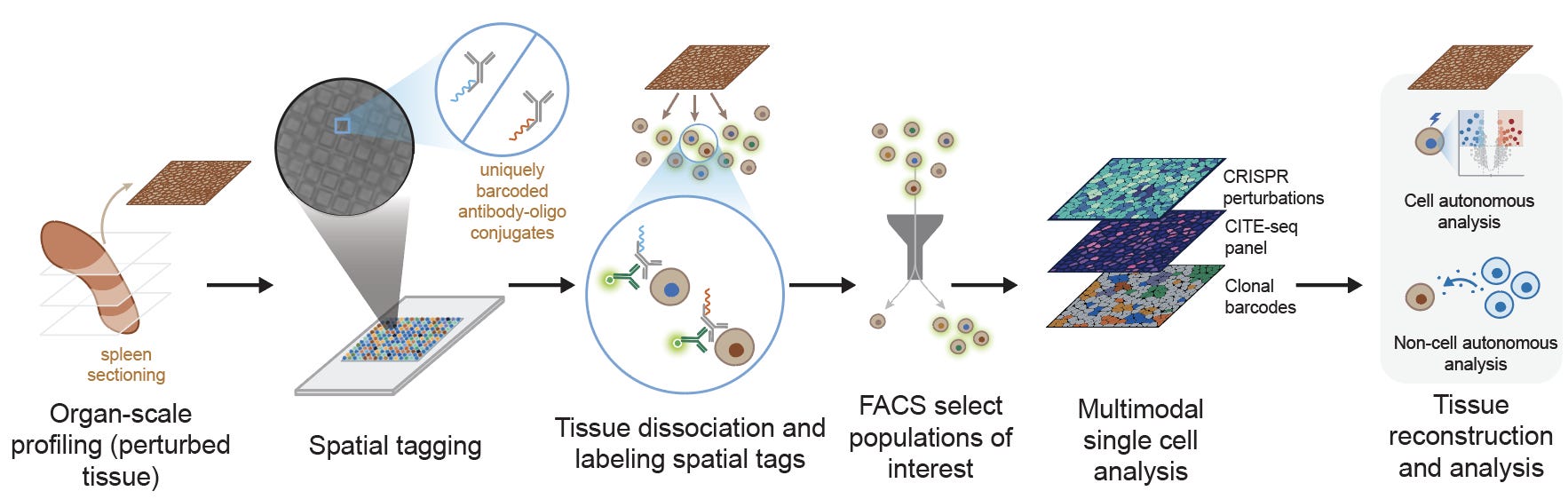
“It’s one extra step ahead of a single cell RNA-seq workflow where we can get all the information that we can get from standard Perturb-seq, but we also know the spatial location.”
That’s how my guest this week, Arc Institute Senior Scientist Alexander Nevue, describes PerturbSpace, a new method he and his colleagues introduced in a May 26 BioRxiv preprint.
PerturbSpace is the latest method to marry the power of CRISPR-based perturbation screening, where genes across the genome are systematically targeted and the effects of those perturbations are read out in the transcriptome of the cell in which they were made.
This juncture of CRISPR-based screening and spatial transcriptomics is one of the hottest areas in molecular biology right now, with nearly 10 different methods published in the last two years, from leading scientists including Genentech’s Aviv Regev; Harvard University’s Xiaowei Zhuang, the inventor of MERFISH and cofounder of Vizen; Yale University’s Rong Fan, and the Broad Institute’s Sami Farhi.
On a personal note, this discussion brought me back to when I was covering the flurry of CRISPR-based technologies that were coming out a decade ago. I reported on the first perturb-seq papers when they came out in 2016 (!) and its fascinating to see it intersect with two more recent trends I’ve been following: spatial biology and AI virtual cell development.
Join Alex and I as we discuss the PertubSpace workflow, its advantages and disadvantages compared to other spatial perturb-seq methods, and where he sees the data from these screens making the most impact.
You can also listen to the interview on Apple Podcasts and Spotify
Links to other publications of spatial perturbation screening methods with notable authors:
PerturbView. Aviv Regev and Erik Lubeck of Genentech. https://www.nature.com/articles/s41587-024-02391-0
Large-scale pooled in vivo CRISPR screening. Jonathan Weissman of MIT and Harvard’s Xiaowei Zhuang, inventor of MERFISH and cofounder of Vizgen. https://www.biorxiv.org/content/10.1101/2024.11.18.624217v3
SPAtial Cell Exploration (SPACE). Joe Beechem of Bruker/NanoString, in collaboration with Merck. https://www.biorxiv.org/content/10.1101/2025.09.14.675819v2
Perturb-DBiT. Rong Fan of Yale University, inventor of DBIT family of methods and cofounder of AtlasXOmics. https://www.researchsquare.com/article/rs-6481967/v1
CRISPRMap. Jellert Gaublomme of Columbia University, Dan Landau of Weill Cornell Medicine. https://www.nature.com/articles/s41587-024-02386-x
Perturb-FISH. Sami Farhi of the Broad Institute. https://www.cell.com/cell/fulltext/S0092-8674(25)00197-7
NIS-Seq Jonathan L. Schmid-Burgk of University Hospital Bonn. https://www.nature.com/articles/s41587-024-02516-5
Spatial Perturb-Seq. Wei Leong Chew of A*STAR GIS. https://www.nature.com/articles/s41467-026-69677-6


