

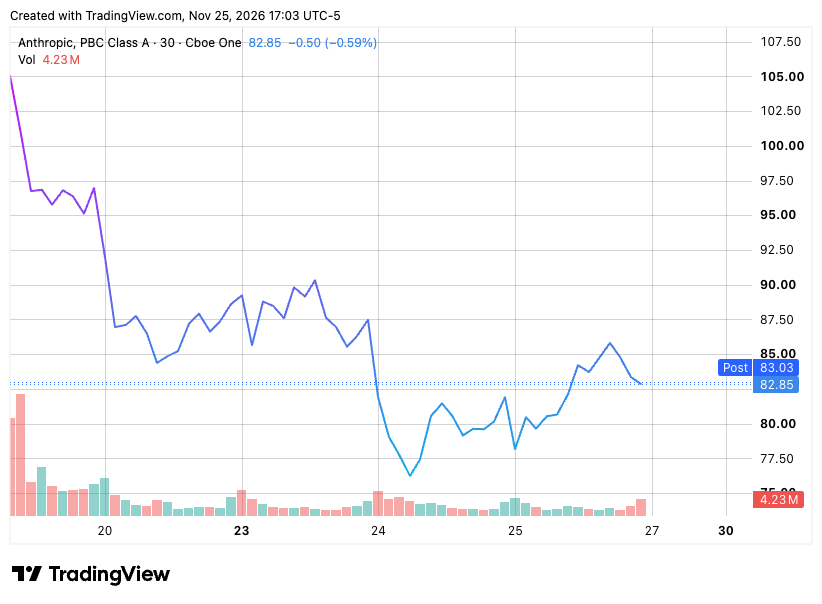
Anthropic’s IPO has come and gone; the stock went up, then down; whether these initial investors cared about the company’s ambitions in science and healthcare may never be known, but those ideas were front and center in how Anthropic pitched itself to them.
“Scientific innovation” and “cures for major diseases” were mentioned in the first paragraph of Anthropic’s prospectus and the rest of the document gave some new insight into where those fields fit into the company’s future.
Anthropic’s Claude Enterprise is already the AI platform of choice for Eli Lilly and Bristol Myers Squibb and nine of the 10 largest pharma companies in the world are customers, the company said.
The company has several products to offer these kinds of customers, including Claude Science, Claude for Life Science, and Claude for Healthcare. The company is also “extending Claude into robotics,” with its Model Hardware Standard, which will allow AI agents to operate lab equipment such as microscopes and liquid handlers.
Other customers mentioned in the prospectus include:
The Gladstone Institutes
The University of California, San Francisco
Australia’s Garvan Institute of Medical Research
World Health Organization Regional Office for Africa
The Gates Foundation
Revenue is skyrocketing, with approximately $17.0 billion in the third quarter of 2026 alone and $33.24 billion in the nine months ended Sept. 30, up thirteenfold over $2.55 billion for the same period in 2025.
That comes against a net loss of $104.04 billion, or $50.10 per share, for the nine months ended Sept. 30 (including $3.3 billion in stock-based compensation), compared to a net loss of $25.10 billion, or $13.90 per share for the prior-year period.
Anthropic had $212.68 billion in cash, cash equivalents, and short-term investments as of Sept. 30.
Anthropic CEO and Cofounder Dario Amodei has repeatedly used lofty language to describe his belief in the potential for artificial intelligence. Like many top AI execs, he likes to say that he believes “that AI could cure most major diseases in the next 5-10 years.” That kind of language is also present throughout the prospectus, though biology also presents a certain kind of corporate risk that Anthropic felt compelled to state.
Along with risks of economic disruption and the use by authoritarian governments “create high-tech surveillance states [and] deepen repression,” Anthropic’s AI could be “misused by those who wish to do harm, for example to conduct cyberattacks or to design biological weapons.”
Anthropic is not the first company to list biosecurity as a corporate risk (e.g. Twist Bioscience mentioned it in the prospectus for its 2018 IPO.) However, Anthropic specifically notes that misuse “in the domain of biology, could result in even greater harm” than from cyberattacks.
The scientific enterprise could even benefit materially from the IPO. Anthropic has set aside at least 5 percent of its equity for a “fund devoted to the public good” with science, medicine, and biosecurity listed among the potential program areas.
At a market capitalization of $1.08 trillion on Nov. 25, that’s an endowment of more than $50 billion.
Editor’s disclosure note: Ion Genomics is an Anthropic customer.
Ion Genomics News
Happy Thanksgiving to everyone celebrating it this week. I won’t have a podcast this Friday, but look out next week for a discussion with Eric Olivares, a genomics industry veteran who has started a company called LSMC to try to learn from his time at Invitae and get industrial-scale whole-genome sequencing for diagnostics to work this time.
This year, I’m thankful for everyone who has helped me get Ion Genomics off and running. Of course, that includes you, the subscribers. If you’re thankful to have a free weekly genomics newsletter and my written and podcasting coverage of the field, you can make me even more thankful with a one-time contribution to keep Ion Genomics going:
https://buy.stripe.com/aFa5kF1vZ6RcfY3a3A73G00
If you still want a podcast to listen to, check out last week’s discussion with Broad Institute researcher and neurologist Andrew Kraft on single-cell and spatial mapping of the brain.

Other Genomics News
Natera to Track ctDNA in CRISPR-Edited Cell Therapy Trial

Natera announced a collaboration with KSQ Therapeutics to use the Signatera Genome test in an ongoing phase I/II clinical trial of an investigational cell therapy for advanced cancers.
Illumina Tops AI Cell Challenge, but Models Struggle to Predict Biology

A team of bioinformaticians from Illumina has won the 2026 Virtual Cell Challenge, a competition that tests the ability of AI models to predict the results of genetic perturbation experiments.
Guardant Health on Nov. 19 announced the US clinical launch of Guardant Reveal Ultra, a tumor-informed molecular residual disease (MRD) test for solid tumors.
The test uses patient-specific genomic alterations from thousands of targets spanning all major variant classes, including structural variants. Guardant said it has demonstrated detection sensitivity of 1 part per million or below across major tumor types, based on validation with thousands of clinical samples. The company did not disclose pricing, payer coverage, turnaround time or which tumor types are included in the validation.
Memorial Sloan Kettering to Supply Data for Noetik AI Cancer Models
Noetik is collaborating with Memorial Sloan Kettering Cancer Center to develop AI models of cancer biology.
Shares of BillionToOne dropped after a short-sellers’ report from Fuzzy Panda Research, as reported by GenomeWeb. The report “made a number of allegations … including that the company is being investigated for improper billing practices, that it has overbilled for carrier screening tests, that it illegally caps patient deductibles and copays, and that its single-gene noninvasive prenatal test (NIPT) has an issue with false negative results.” BillionToOne told GenomeWeb it believes the report contains “inaccurate, distorted, unsupported, and highly misleading claims.”
Quantum-Si said its Proteus platform has detected all 20 naturally occurring amino acids at the single-molecule level, achieving this goal ahead of schedule. The company is now working to incorporate detection of all these amino acids into a developmental sequencing kit for use on Proteus instruments but did not provide a launch date.
Tagomics Raises £10M to Scale NGS-Based Drug Safety Testing
Cambridge, UK-based Tagomics has closed a £10 million ($13.1 million) seed financing extension, bringing its total funding to £19 million.
My Omics Reading List
Lorenzini, Balderson, Lavalle, et al. “Joint single-cell capture of Cas9 edits and transcriptomes reveals on- and off-target effects on gene expression.” Nature Methods. Nov. 16, 2026
Researchers from the Salk Institute and Integrated DNA Technologies (IDT) present Superb-seq, a new method for identifying which individual cells carry both intended and unintended CRISPR edits and how those edits affect gene expression.
“There are some people that have worked on this off-target issue before that have an awareness of how bad it is, but for many people that pick up CRISPR to use it in the lab, the extent of this problem will really come as a surprise,” Salk researcher and senior author Graham McVicker said in a statement. “I knew off-targets were an issue, but they were far more frequent than I was expecting.”
The team tested Superb-seq on 34,000 cells across three cell lines. By linking edits in individual cells to changes in gene expression, the researchers gained a more detailed view of their potential effects. The technology could help flag potential safety concerns earlier in the development of gene-editing therapies.
Elsewhere on the Internet
Grand Theft Auto VI is finally out and the way I like to describe the games to non-gamers is as a satirization of current American culture eclipsed only by The Simpsons and The Onion. Since at least GTA III, the writers have absolutely skewered the US, from its overall premise down to the ads that run on the in-game radio.
I haven’t started playing this one yet, however, I’ve learned that there is a side mission involving DNA! Following a QR code in a bathroom leads you meet a conspiracy theorist who believes that a corporation is harvesting DNA from citizens through their poop in order to clone them.
If I don’t get a newsletter out on time in the near future, it’s probably because I’ve started playing and am stuck painting a house.