

In May I reported that scientific image sleuths had found that certain promotional images for antibodies on Thermo Fisher Scientific’s website had been improperly edited. A new analysis suggests the problem is industry-wide.
An Aug. 25 blog post by Reese Richardson, a scientific integrity expert at Northwestern University, showed how he and others have compiled nearly 19,000 manipulated images “presented as validation data for 17,495 unique antibody products sold by 15 different vendors.”
In addition to Thermo Fisher, other companies selling antibodies with allegedly faked validation data include Abcam, Novus Biologicals/R&D Systems, Proteogenix, Origene, Millipore Sigma, LSBio, Bioss, Boster Bio, G-Biosciences, GeneTex, HUABIO, Antibodies.com, Abnova, and Santa Cruz Biotechnology.
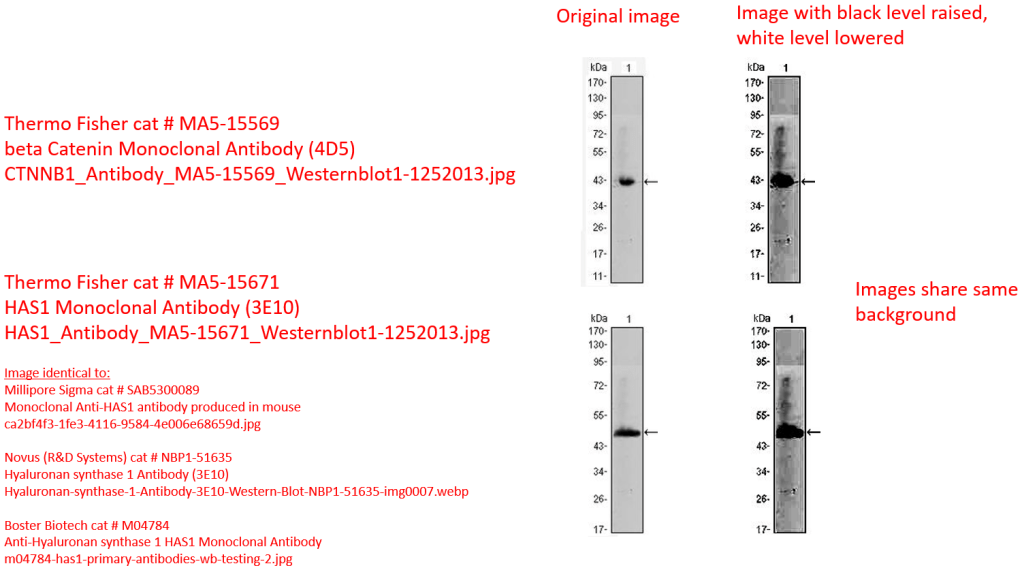
Though Thermo Fisher had 5,580 suspect images across more than 4,800 products, it was not the biggest source of suspect images. That distinction went to St. Louis-based G-Biosciences, with 6,388 images across 6,373 products.
There’s a potential explanation for why the problem is occurring everywhere one looks. “It is clear that many of these vendors are using the same images as one another for their own versions of the same product,” Richardson wrote.
Ion Genomics News
Enjoying this free newsletter? Between the reporting, writing, and monitoring the news, it’s a lot of work behind the scenes. A one-time contribution will help keep me fueled on coffee (or burritos): https://buy.stripe.com/aFa5kF1vZ6RcfY3a3A73G00
Other Genomics News
10x Genomics and Parse Biosciences: The Last Dance-Off?
10x Genomics and Parse Biosciences met again this week in a Delaware federal courthouse for a patent infringement trial, a potentially pivotal moment for the single-cell sequencing technology market.
This case, inherited (acquired?) by 10x from Scale Biosciences, is one of its last and best chances to squeeze out Parse. So far, 10x has failed to use its core IP to trip up Parse and if it is unsuccessful here, it’s unclear where 10x turns next to continue applying legal pressure.
However, I have heard rumblings that Scale’s IP position is strong. Both companies commercialized single-cell tech based on combinatorial barcoding strategies. One probably only has to look at their dealings with NanoString and Bruker to see what 10x management will try to extract if they win. A 2025 settlement led to $68 million in licensing fees and an ongoing royalty on spatial biology products, paid by Bruker.
Parse had earlier convinced the judge to invalidate one of the patents, but was unable to convince him to invalidate all-three in a pre-trial motion.

By now, the jury is set, opening arguments have been made, and evidence is being presented. Key witnesses so far include Scale Cofounder and Stanford University researcher Garry Nolan, former Scale CEO Giovanna Prout, 10x Cofounder and CTO Michael Schnall-Levin, and Parse Cofounder and CTO Charlie Roco. The judge said both sides are on a timer and will have until the end of the week to present evidence. Perhaps next week’s newsletter will feature a jury verdict.
Guardant Health to Appeal Quarter-Billion-Dollar Legal Bill in TwinStrand Lawsuit

A US federal judge has ordered Guardant Health to pay $138.9 million for royalties and supplemental damages as well as a 6 percent royalty on sales of certain products and services beginning July 1.
Twist Bio Shares Spike After Anthropic Reveals Collaboration on Protein Design Experiment

Twist Bioscience saw its share price jump nearly 25 percent from where it began the week, with the biggest rise following an Aug. 19 announcement from artificial intelligence company Anthropic that it has used Twist to verify its investigational work into AI-designed proteins.
MGI Tech First-Half Revenue Rose 19 Percent, Led by Multiomics Growth
MGI Tech reported first half 2026 revenue grew 19 percent year over year to 1.34 billion yuan ($199.4 million) from 1.15 billion yuan in the prior-year period.
BGI Genomics also reported first half financials with total revenue up 10 percent, driven by 31 percent growth in precision medicine testing revenue to 917.2 million yuan.
BGI closed offices in Colombia and South Africa while setting up a new German subsidiary called DNB Tech, as reported by Huanjia Zhang at GenomeWeb (paywall.)
Gilead Sciences Taps Deepcell to Codevelop AI Model of Chinese Hamster Ovary Cells
AI and biotech startup Deepcell said it is collaborating with Gilead Sciences to codevelop a custom AI foundation model for Chinese hamster ovary (CHO) cell morphology.
Network Bio Emerges with $50M to Build AI Models, Partners with Nvidia
Network Bio, a startup building artificial intelligence models for use in personalized medicine, launched Aug. 19 with $50 million. The company also announced a partnership with Nvidia to build a model based on cell-free RNA sequences and a $30 million codevelopment and licensing agreement with an unnamed Fortune 100 healthcare company.
Pixelgen Technologies Closes $15.5 Million Series B Financing Round
Pixelgen Technologies said Aug. 20 it has closed an oversubscribed $15.5 million Series B financing round.
Bioptimus Partners With Cancer Research Horizons to Access Colorectal Cancer Data
Bioptimus, a Paris-based artificial intelligence and biotech company, said it has partnered with the UK’s Cancer Research Horizons to access a multimodal colorectal cancer dataset covering more than 1,750 patient profiles.
Japanese Lung Cancer Study to Use Pillar Biosciences’ Liquid Biopsy Test
Pillar Biosciences said Aug. 19 that its oncoReveal Essential+ liquid biopsy assay has been validated for use in genomic screening of blood-based samples from lung cancer patients participating in the LC-SCRUM-Asia project in Japan.
OmicsBank $2.3M Seed funding
OmicsBank, a clinical data company, announced $2.3 million in seed funding from Redesign Health. The company’s technology has captured longitudinal EHR data from 12.5 million patients, 6 million pathology slides, and 500,000 genome sequences and is in use at 90 hospitals and diagnostic labs in Asia.
“Drug development and healthcare AI are becoming increasingly sophisticated, but the data powering them still represents a relatively narrow slice of the world,” CEO and Cofounder Sumit Sinha said in a statement. “We’ve built the infrastructure to make rich clinical and biological data from Asia and other underrepresented populations available for research, ethically and at scale, while remaining compliant with local and international laws.”
Weill Cornell Medicine has created a new Department of Systems and Computational Biomedicine, naming Dan Landau, an oncologist and researcher known for single-cell profiling and whole-genome sequencing approaches to cancer biology, as its inaugural chair, effective Sept. 1. The department carries a mandate to build large patient-derived datasets combining genomics, wearable data, health records, and imaging for AI-driven disease research. The role is backed by a $20 million gift from Andrew and Ann Tisch.
My Omics Reading List
Leon-Perinan, et al. “Ultrafast and reference-free sequence discovery in single-cell data.” Nature. Aug. 26, 2026.
Researchers from the Max Delbrück Center for Molecular Medicine introduce Malva, a computational platform that enables “ultrafast, species-agnostic and reference-free interrogation of the raw sequence space.”
“Malva transforms single-cell atlases from static gene count tables into dynamic, sequence-resolved resources that may help to bridge human–machine reasoning about biology.”
It allows researchers to query single-cell data using natural language — – asking, for instance, about cells expressing mitochondrial genes in tumor samples — – and to retrieve sequence-level results without a reference genome.
Abolhasani. “The Lab that Learns.” Science. Aug. 20, 2026.
Abolhasani notes: “AI systems generate hypotheses and suggest experiments faster than most laboratory hardware can perform and validate them.”
Elsewhere on the Internet
American cultural icon Dolly Parton died this week at 80, a loss of one of the few nearly universally-liked public figures left in this country. One of my favorite internet “facts” that I’ve seen go around a few times now is that Parton wrote “Jolene” and “I Will Always Love You” (made even more famous by Whitney Houston) on the same night.
That may or may not be true, as Dolly Parton shared in this 2020 video; however, it’s still remarkable that they emerged from the same burst of songwriting that led to the album featuring both songs, also titled Jolene.