

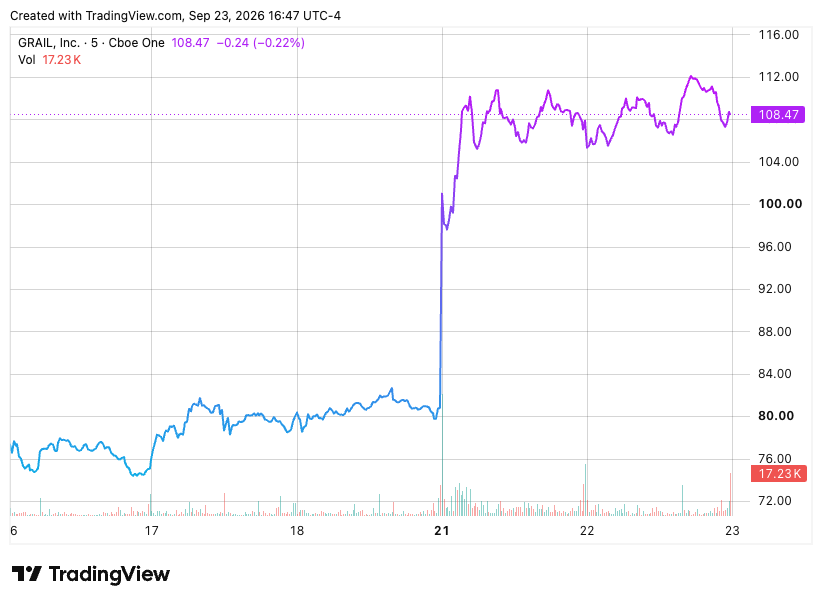
Grail’s stock surged more than 30 percent earlier this week as investors reacted to briefing materials released ahead of the company’s FDA Advisory Committee hearing, taking place Sept. 23.
The panel meeting and subsequent vote is a hugely important step for Grail’s Galleri early-cancer detection test as well as for the entire multi-cancer early detection (MCED) market. Galleri is the first and so far most thoroughly-studied test, but Abbott’s Exact Science and others have similar tests in development.
Following the failure of the UK NHS’s Galleri trial to meet its primary endpoint of a reduction in late-stage cancers, disclosed earlier this year and published Sept. 22 in the New England Journal of Medicine, FDA approval is a chance for Grail to get positive news out there again: and an FDA stamp would definitely be positive.
Investors seem to think that at least some form of FDA approval is likely. While this is not the finish line for Galleri, it is hugely important. The “Medicare Multi-Cancer Early Detection Screening Coverage Act,” which was signed into law earlier this year, opens the door for Medicare to cover Galleri and other MCED tests, provided they’re approved by the FDA.
Without the new law, Grail would probably have had to continue generating evidence to support a US Preventive Services Task Force recommendation. Instead Grail dumped money into Washington’s K Street to help it blaze a shortcut.
According to mandatory disclosures, since 2020 Grail has spent more than $15 million lobbying congress to provide medicare coverage for MCED tests, including millions on the “Medicare Multi-Cancer Early Detection Screening Coverage Act” by name. That money went to over a dozen different lobbying firms.
As noted by genomics commentator Alex Dickinson on LinkedIn, the committee seems keen to push Grail by zeroing in on what “early detection” means and if the test could be approved simply to detect multiple cancers without that modifier.
Also at stake is how this FDA decision sets precedent for later MCED tests. Public comments from liquid biopsy experts led by Johns Hopkins University researcher and Exact Science Cofounder Bert Vogelstein noted that:
Due to the limitations of molecular tissue-of-origin (TOO) approaches to follow-up of MCED tests detailed in this Comment, it is important that TOO-based prediction does not become a precondition for FDA-approval of MCED tests. Validated non-TOO follow-up strategies, including whole-body contrast-enhanced PET-CT imaging should be considered acceptable, evidence-based options for positive MCED test results.
As an accompanying op-ed in NEJM suggested, we are only a step closer to a world in which cancers can truly be detected early. What happens with this FDA AdCom meeting will be another step: in which direction, one cannot say.
Ion Genomics News
Tune in to the podcast channel on Friday to hear about the Chinese genomics industry from Matt Marlowe, a life science marketing professional who also runs a Substack about the sector. He is fresh off a multi-week trip around the country doing site visits and taking meetings. Conveniently, Chinese President Xi Jinping is in the US this week to talk trade, AI, and other topics with the US government.
Other Genomics News
White House Eyes Takeover of NIH Funding Decisions
As first reported by the Washington Post, the White House and NIH Director have discussed a proposed executive order that would give the White House unprecedented power over NIH grant making.
Science’s Joceyln Kaiser (soft paywall) notes that under a proposed executive order, a new board co-chaired by the director of the White House Office of Management and Budget Russell Vought would be able to veto any grants. What could go wrong?
Illumina ascended to the S&P 500 on Sept. 21. The index of US stocks is a key barometer of the US stock market. Shares of the DNA sequencing giant are up 92 percent over the last six months.
Natera's Signatera Wins Japanese Approval as Bladder Cancer CDx
Natera’s Signatera test has received regulatory approval from Japan’s Pharmaceuticals and Medical Devices Agency (PMDA) as a companion diagnostic in muscle-invasive bladder cancer (MIBC).
Twist Bioscience will supply antibody characterization data services for Eli Lilly’s TuneLab, an artificial intelligence-based drug discovery platform. Twist’s shares are up even more than Illumina’s: 275 percent over the the same period.
Eli Lilly Taps Twist Bioscience to Supply Antibody Data for AI Drug Discovery Offering

Twist Bioscience will provide antibody data for Lilly TuneLab, an artificial intelligence-based drug discovery platform created by Eli Lilly.
As MRD testing volumes rise for companies like Natera, Guardant Health, and others, so too are insurance denials, reports Alexandra Byrne of GenomeWeb (paywall.)
The US Department of Health and Human Services filled eight seats on the US Preventive Services Task Force. The seats had been vacant for months and the full panel hasn’t met in over a year.
Many of the new members are specialists and not primary care physicians, a fact that drew criticism from American Medical Association President Willie Underwood:
“The composition of this new slate represents a significant departure from the Task Force’s traditional membership,” he said in a statement. “We believe maintaining a strong primary care voice must remain central to its work.”
Protein analysis company Nuclera today announced the appointment of Carl Raimond as CEO effective immediately. Raimond was formerly president and chief commercial officer of Olink, now part of Thermo Fisher Scientific. Cofounder and former CEO Michael Chen will transition to the role of chief scientific and business officer.
My Omics Reading List
Lee, D., Koutrouli, M., Masse, N.Y. et al. “Single-cell atlas of transcriptomic vulnerability across brain disorders.” Nature Sept. 23, 2026.
The centerpiece of a nine-paper package published across Nature’s family of journals, this study presents data on a single-cell transcriptome atlas of more than 6 million nuclei from 1,494 unique donors, including patients with eight different conditions across dementia and mental illnesses, as well as “neurotypical” controls.
“By analyzing millions of cells across multiple brain disorders, we found that many diseases share common molecular pathways while also exhibiting distinct cellular signatures,” Donghoon Lee, first author of the paper and a researcher at the Icahn School of Medicine at Mount Sinai, said in a statement. “These findings provide a framework for understanding why different neurological and psychiatric disorders converge on similar biological processes while maintaining distinct disease-specific features.”
–
Yoon et al. “A noncontiguous code for RNA-guided DNA recognition at the origin of CRISPR-Cas.” Science. Sept. 17, 2026.
Researchers led by Jennifer Doudna of the University of California, Berkeley, describe what appears to be an “ancient progenitor of CRISPR systems.”
Dubbed viral interference programmable repeats (VIPR), these may evolved in viruses to help them fight off other viruses – weapons that bacteria later turned against their originators.
Also check out the long-form press release from the Innovative Genomics Institute’s Andy Murdock.
Elsewhere on Substack
Nava Whiteford, writing on his Substack, said that:
[ChatGPT has] done some quite interesting nanopore data analysis and given an Illumina MiSeq imageset built a complete image analysis and basecalling pipeline.
I previously wrote a pipeline to do this. It took me about a year, ChatGPT did it in about 3 hours.
Check out his article for his full list of prescriptions for data documentation and accessibility.

Elsewhere on the Internet
The Love Hypothesis movie is finally out on Prime Video. Check back next week for my official review!
Also:

