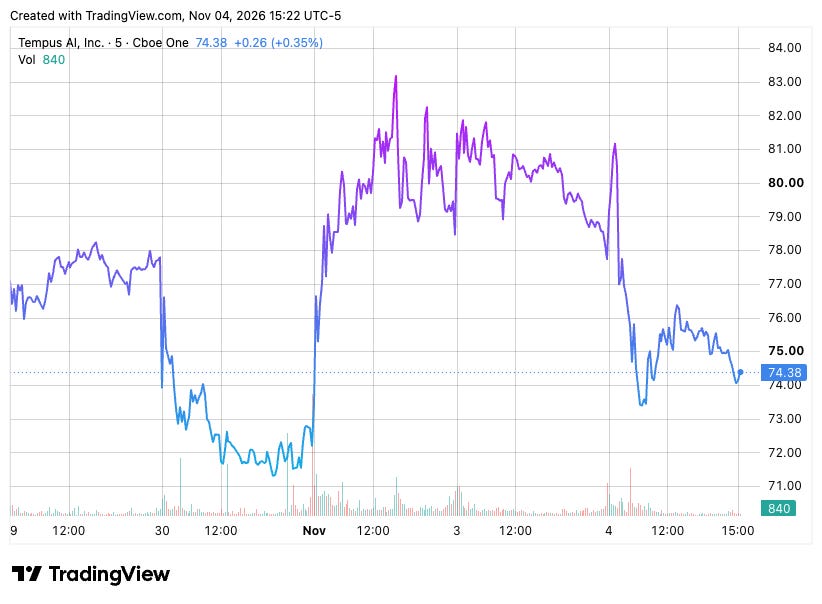
Tempus AI reported revenue growth of 23 percent in the third quarter, driven by data licensing oncology testing volume.
On Nov. 2, Tempus reported total !3 revenue of a total of $411.5 million, compared to $334.2 million a year ago, beating the consensus Wall Street estimate of $409.3 million.
“Q3 was an incredibly strong quarter for Tempus with broad-based growth across both our diagnostics and data & applications businesses,” CEO and cofounder Eric Lefkofsky said on a call with investors following the release of results.
Revenue from the company’s diagnostics segment was $303.5 million, up 20 percent year over year, on growing oncology test volume. Oncology revenue was $172.6 million, up 28 percent year over year. Hereditary cancer testing revenue was $111.3 million.
The data & applications segment posted revenue of $108.1 million, up 33 percent, with insights data licensing revenue growing 29 percent.
Lefkofsky also highlighted a data licensing deal with Bristol Meyers Squibb announced in October.

“This is one of our largest strategic collaborations to date, and it’s nice to see BMS join the likes of AstraZeneca, Merck, GlaxoSmithKline and BioNTech,” he said. “As I’ve said before, if we signed just one of these big collaborations, we would be content. We’ve signed three this year alone.”
Minimal residual disease (MRD) testing volume reached approximately 12,000 tests in the quarter, up roughly fourfold from the year prior.
Net loss for the quarter was $14.9 million, or $.08 per share, compared with a loss of $80 million, or $.46 per share, in the third quarter of 2025. Adjusted EPS was $.07, beating the consensus Wall Street estimate of $.01 loss per share.
The company ended the quarter with $854.4 million in cash and marketable securities.
Tempus noted that its pending acquisition of Personalis has been cleared by regulatory bodies, Tempus said in a statement. A shareholder meeting to vote on the deal is planned for Nov. 30.
The company also announced plans to build a research platform of 100,000 whole genomes linked to longitudinal clinical data.
The company raised its full-year 2026 revenue guidance to between $1.60 billion and $1.61 billion, implying roughly 25 percent annual growth.