

This story has been updated to correct Mike Hunkapiller’s titles at PacBio.
Earnings season is in full swing again and today came with a doozy of an update: Christian Henry has stepped down as CEO of Pacific Biosciences, to be replaced by Mark Van Oene, formerly the Chief Operating Officer.
The announcement comes as second quarter revenue was down 2 percent year over year, at $39.0 million, compared to $39.8 million a year ago.
It also follows another round of layoffs at the long-read sequencing company. Several people, including myself, noticed a LinkedIn post by former PacBio employee Elizabeth Tseng, lamenting that she had been let go last week. PacBio did not respond to my requests for comment; however, according to a LinkedIn comment from SynBioBeta’s community manager Aaron Blotnick, approximately 40 people were laid off. It’s the latest in a string of layoffs for PacBio.
Henry was appointed in March 2020, taking over from longtime CEO and Cofounder Mike Hunkapiller. He oversaw the rise of HiFi sequencing and the launch of the flagship Revio instrument but was also responsible for the ill-fated Onso short-read sequencing platform, a project that burned hundreds of millions of dollars in acquisition costs and R&D. Henry will remain on the board of directors.

Earlier today, PacBio announced a slew of improvements to its Vega benchtop systems, driven by the pending arrival of SPRQ-Nx chemistry to that platform. Along with a software update, Vega users can expect see an increase in total output from 60 Gb to 90 Gb per run. Moreover, the US list price per run will drop from $1,100 to $995. PacBio suggests that’s a 40 percent improvement on cost per Gb. The software update also adds two- and four-hour run options, new methylation callers, and compliance features.
Moreover, GenomOncology has launched an end-to-end workflow for somatic whole-genome sequencing in oncology, pairing PacBio’s HiFi WGS research-use only secondary analysis pipeline with the company’s Pathology Workbench platform. The combined solution addresses the conversion of long-read WGS data, including methylation on PacBio’s instruments, into structured clinical reports.
Illumina has already reported its second quarter results, with a solid 10 percent bump in revenue, year over year.
Sequencing instrument revenue had an eye-popping 31 percent increase over the prior-year period, but obscured some odd numbers going on underneath. (Hat tip to Canaccord Genuity Kyle Mikson, who flagged this for me in an email.)
On the investor call, Illumina officials said the company placed “more than 95” flagship NovaSeq X instruments in the quarter, or at least 15 more than in the first quarter of 2026. Yet, sequencing instrument revenue was only $7 million more than in Q1. List price for an X is approximately $1 million, more for the X Plus and Illumina saw an increase in MiSeq i100s as well. What gives?
I’ve reached out to Illumina for comment, but the answer is probably the same as it was in Q1. Following that quarterly results call, Alex Dickinson highlighted comments from Illumina officials explaining that the company had lower instrument revenue than analysts had expected due to a mix of volume discounting and instruments placed under reagent rental deals or leases. Earlier this year, Illumina struck a deal with Devyser to provide certain of that company’s customers with sequencers under a reagent rental.
Illumina Q2: Clinical Sequencing, Strong Instrument Sales Drive 10 Percent Revenue Growth
Illumina said on July 30 that its second quarter revenues rose 10 percent year over year.
Ultima Genomics Lands BaseClear as First European Certified Service Provider
Netherlands-based genomics services provider BaseClear will offer sequencing services on Ultima’s UG200 Platform for customers across Europe, the companies announced July 29.
Other companies reporting second quarter earnings in the last week:
Guardant Health Q2 Revenues Rise 44 Percent on Oncology and Shield Growth

Guardant Health said on July 30 that its second quarter revenue rose 44 percent year over year.
Guardant, Myriad, Tempus, Veracyte, Castle Bio: Q2 Results Megapost

Five cancer testing companies reported second-quarter results on July 30, with results ranging from strong beats to a material miss.
Twist Bioscience Fiscal Q3 Revenue Rises 23 Percent

Twist Bioscience said prior to the market open on Aug. 3 that its fiscal third quarter revenues rose 23 percent year over year.
On Aug. 4, Twist announced an estimated $300 million public offering of common stock: 3,125,000 shares at $96.00 per share. In a statement Twist said it intends to use the proceeds from the offering along with cash on hand to fund R&D, expand manufacturing capacity and product offerings, and for working capital and other general corporate purposes. The company expects the offering to close on August 6.
Adaptive Biotechnologies MRD Testing Drives Q2 Revenue Growth

Adaptive Biotechnologies after the close of the market on July 29 that its second quarter revenue grew 22 percent year over year.
Other genomics news
George Church Joins IndyGene US Advisory Board
IndyGene US Bio said July 30 that Harvard Medical School’s George Church has joined its scientific advisory board. The company is developing blockchain-based technology for accessing data from populations historically underrepresented in genomic datasets. “The future of medicine depends on ensuring that the biological data used to discover and develop therapies reflects the diversity of the people those therapies are intended to serve,” Church said in a statement. “Inclusive datasets are essential to delivering more effective, more affordable medicines for everyone.”
Inocras Raises $31 Million Series B Round to Fund US Expansion
Inocras has raised $31 million in an oversubscribed Series B financing round, bringing its total funding to approximately $100 million.
Relation, GSK Deepen AI Drug Discovery Partnership With $110M Deal
Relation Therapeutics said it has expanded its collaboration with GSK, making the AI-first drug discovery company eligible for up to $110 million in upfront and success-based milestone payments under the new agreement.
MGI Australia and Australia’s QIMR Berghofer National Centre for Spatial Tissue and AI Research (NCSTAR) have signed a memorandum of understanding to give researchers access to MGI technologies including DNA sequencing, STOmics spatial transcriptomics, droplet-based single-cell sequencing, and proteomics. The MOU lets NCSTAR and collaborating Queensland groups trial and validate the technologies at the existing MGI ANZ Customer Experience Centre on the QIMR Berghofer campus, and includes technical training and knowledge exchange between the two organizations.
New England Biolabs has released the Monarch Mag Cell-free RNA (cfRNA) Extraction Kit, which enables isolation of low-abundance, circulating cfRNA and exome-associated RNA from biofluids including plasma, serum, urine, and cerebrospinal fluid.
My Omics Reading List
Researchers from the Regeneron Genetics Center present data on rare variants associated with energy and metabolism.
“Ultra-rare protein-truncating variants in FNIP1 (allele frequency, 0.01 percent), which encodes a suppressor of energy expenditure and mitochondrial metabolism, are associated with a lower [ratio of triglyceride to high-density-lipoprotein cholesterol], lower liver fat, lower glycaemia, favourable fat distribution, and around 60 percent lower odds of cardiometabolic disease.”
Hindy, G., Adam, R.C., Sosina, O. et al. “FNIP1 variants are associated with favourable metabolism in 1 million humans.” Nature (Aug. 2026).
—
Here we describe a systematic effort (‘Codebook’) to determine the sequence specificity of 332 putative and poorly characterized human transcription factors (TFs.) More than 4,000 independent experiments, encompassing multiple in vitro and in vivo assays, produced motifs for just over half (177; 53 percent) of the TFs, of which most are associated with only a single protein. These results extend the vocabulary of sequence recognition encoded by human TFs by around 130 distinct motifs.
Jolma, A., Laverty, K.U., Fathi, A. et al. An expanded codebook of human transcription factor DNA-binding specificity. Nature (Aug. 5, 2026). https://doi.org/10.1038/s41586-026-10798-9
—
Wenckstern, J., Jain, E., von Querfurth, B. et al. “The Virtual Tissues foundation model resolves spatial proteomics across scales.” Nature (Aug. 5, 2026).
Other Science News: Charles Darwin’s Win Streak Continues
A 150-year-old prediction by Charles Darwin appears to be correct, according to a new study on carnivorous plants.
In 1875 Charles Darwin suggested that some species from Saxifraga, a genus of flowering plants typically found in alpine environments, may be carnivorous due to their possession of sticky glandular hairs that can trap insects.
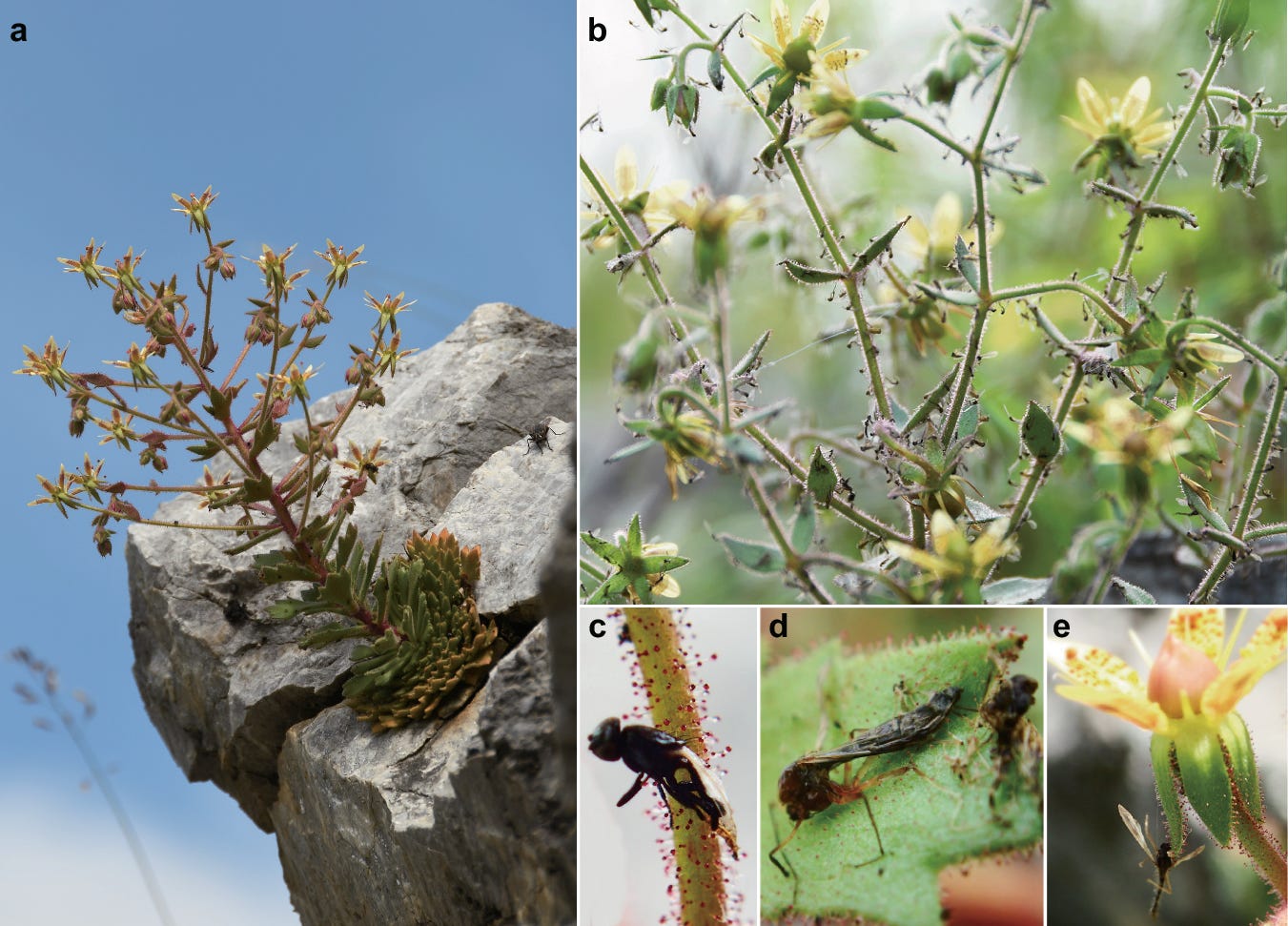
While many plants exhibit carnivorous traits such as prey capture, to be formally classed as carnivorous, they must also show adaptations for digesting and absorbing nutrients from prey. A study published Aug. 4 in Nature Communications show that Saxifraga candelabrum, which grows in high-elevation areas of Southwest China, can attract, trap, and digest insects, absorbing nitrogen from them. Field observation showed capture of insects in the plant’s glandular hairs and fluorescence tagging was used to identify activity of the digestive enzyme phosphatase.
Genetic analysis also found similarities with other independently evolved carnivorous plants, including genes linked to prey attraction, digestion, and nutrient absorption.
Elsewhere on the internet
Bringing it full circle from the top, we have another story about a sequencing CEO whose acquisitions didn’t pan out. On July 30, AI infrastructure company Scale AI has appointed former Illumina CEO Francis deSouza as CEO.
This is a great choice if you’re looking to light billions of dollars on fire, as deSouza did while he was at the helm of Illumina. I’ve done the math, and the Grail acquisition saga basically cost Illumina shareholders most of the billions in profits they reaped over the better part of a decade of dominating the sequencing technology market.
Scale AI appears to be nearly half-owned by Meta, so at least they have deep pockets to turn to if things go south.